

Please see below the details for Aureolin, Barium chromate, Cadmium yellow, Chrome yellow, Indian yellow, Iron yellows, Lead tin yellow, Naples yellow, Orpiment, Realgar, Turner’s Yellow and Yellow lakes.
Aureolin
Kobalgelb, Jaune de cobalt
Potassium cobaltinitrite CoK3(NO2)6 . H2O
Refractive index 1.72 – 1.76. Cubic.
In plane polarised light the pigment is mainly composed of small, acid yellow, equant, isotropic particles that tend to show crystal faces and have low relief. Leaf or spear-shaped crystals, which sometimes show four-fold symmetry, are often present and are characteristic of this pigment. Unfortunately they are fragile and can be so damaged that they may not be recognisable.
Aureolin is prepared by precipitating a cobalt salt in acid solution with potassium nitrite. It is not stable unless thoroughly washed.
The compound was discovered by N. W. Fisher in Breslaw in 1848. Winsor and Newton introduced it as an artist’s pigment in 1861 and continue to offer it.
Mainly used as a watercolour, aureolin has good hiding power and is a very pure yellow. It is fast to light, but it may accelerate the fading of some organic pigments. It can turn brown, particularly in egg tempera, and is decomposed by heat, strong acids and alkalis. The pigment has not proved very popular, probably because, like other cobalt pigments, it is expensive.
Barium chromate
Lemon yellow, Yellow ultramarine, Barium yellow
BaCrO4
Refractive index c. 1.94-1.98 birefringent.
In plane polarized light barium chromate appears as pale yellow clumps of grains or polycrystals. Small particles may have a reticulated surface, but some samples include particles with good crystal faces. Polarization colours appear high, and second order colours may be present. However, an anomalous blue can replace the first order grey particularly in samples where good crystal forms are present. The extinction is undulose. Occasional rhombohedral crystals with symmetrical extinction may be seen.
The pigment is prepared by precipitating it from solutions of neutral potassium chromate and barium chloride. When first precipitated the crystals are octahedral in form, and only develop their characteristic shape after some time. Feller says that some modern forms are too fine to be able to characterise the particles under the optical microscope, but it is not clear what magnification he was working at.
Barium chromate is nearly insoluble in water, but is dissolved by dilute alkalis and dilute mineral acids. It is hardly affected by light. The preparation was described by Vauquelin in 1809, but some years seem to have passed before it was produced commercially. Field seems to have eventually sold it as a cheaper substitute for platina yellow. During the nineteenth century, it was often mixed with strontium chromate, and the name ‘lemon yellow’ was liable to be used for barium chromate, strontium chromate and a mixture of the two. In their 1896 list, Winsor and Newton made it clear that their lemon yellow was barium, not strontium, chromate.
Cadmium yellow
Cadmium sulphide CdS
Refractive index 2.35 – 2.48. Can be Isotropic, anisotropic or amorphous.
In plane polarized light the pigment appears as small, yellow, rounded particles mostly less than 1 micrometre. The appearance is deceptive as these particles may be made up of a mixture of cubic, amorphous or hexagonal sub-microscopic particles. Between crossed polars, most particles and aggregates appear greyish- or greenish-yellow, but thick aggregates appear warmer in colour because the light is depolarized by the rounded aggregates. ‘Rafts’ of amorphous particles are sometimes seen, and these may be surrounded by what appears to be an anisotropic fringe [c.f. Vol 1 Artists’ Pigments].
The rare mineral greenockite, which has a similar composition does not appear to have been used as a pigment. Cadmium yellows are prepared by precipitation from an acid solution of a suitable cadmium salt with either hydrogen sulphide gas or an alkali sulphide. The colour of the precipitate can range from lemon to deep orange, and the colour depends on the size of the particles and whether they are amorphous or crystalline. This, in turn, is determined by the conditions at the time of precipitation. Cadmium yellow dissolves readily in cold strong acids but is not affected by light and is stable in all normal conditions.
The compound was observed by Strommeyer as early as 1817 and was used by Melandri in 1829 [Gettens and Stout], but the pigment did not become commercially available until the late 1840s. It was shown at the 1851 exhibition, and both Robersons and Rowneys were offering whole cakes for five shillings (25p) in that year. Cadmium yellow lithopone was introduced in 1927 and this was described as having all the fastness to light and heat of the pure sulphide but with slightly less covering power. However, it was considerably cheaper and today, most of the pigment sold as cadmium yellow is cadmium yellow lithopone.
Chrome yellow
Primrose chrome, Lemon chrome, Chrome deep, etc
Lead chromate PbCrO4
Refractive indexes 2.31 to 2.49, monoclinic.
In plane polarised light the particles in most nineteenth-century and early twentieth-century samples appear as yellow rods which have parallel extinction and are usually length slow. The effect of the interference colour is, for a group of particles, a greyish yellow green. However one sample of 1805 showed small rods many of which appeared to be length fast. In most recent samples the particles are much smaller and the elongation is most easily seen when the preparation is viewed between crossed polars. This type also tends to have higher interference colours than the form with longer rods. It is not unusual to find a particle showing first order red. When a pale yellow is produced by the addition of lead sulphate, the rods are much more needle like. Natural lead chromate, the mineral crocoite which does not appear to have been used as a pigment, is strongly pleochroic – deep blood red to light yellow. On rotating the stage, one may just be able to see some of the rods change from a higher contrast when parallel to the direction of the polariser to a weaker one when perpendicular to it. The effect is clearly visible if a x 100 oil immersion apochromatic is used with a well corrected substage condenser and the polariser is rotated rather than the stage. However, the effect can usually be seen, if it is looked for with an achromatic objective at a magnification of c. x 500. Occasional particles formed of three radiating crystals have been seen.
The pigment was prepared by precipitating a soluble lead salt (usually the acetate or nitrate) with potassium or sodium chromate or dichromate. The lighter shades are made by adding a sulphate (usually sodium sulphate) or sulphuric acid to the lead solution. The crystals produced by this method tend to be more obviously elongated and needle shaped than when the pure chromate is made. Light shades are also made by precipitating a mixture of lead chromate and blanc fixe. Several chemists were involved in the investigation of chromium and its compounds. The metal was first isolated by Vauquelin in 1797, and in 1809 he recorded that lead chromate could be prepared in different shades, depending on the conditions of precipitation. However, until supplies of ore were found there was no possibility of its being used to prepare pigments commercially. Field records that chrome yellow was available from several sources by 1814-15. Berger was manufacturing the pigment by 1824. It was not a very expensive pigment: in 1835 Field was charging a shilling (5p) for a watercolour cake, and in 1889 Winsor & Newton listed it at sixpence (2½p) an ounce. The low price meant that it could be used in decorative work and its use is recorded on the Brighton Pavilion in 1818, 1819, and 1821 [Conference poster Art and Chemistry: Colour Paris 1998]. Chrome yellow was frequently precipitated with prussian blue, and sold as ‘chrome green’. Unfortunately chrome yellow usually destroys the prussian blue and the paint becomes less green with time. Nevertheless a number of ninteenth-century chrome green samples made with lead chromate have been found in good condition. A more reliable ‘chrome green’ was also made using zinc chromate in place of lead chromate.
Chrome yellow works well in both oil and watercolour and the fine, even particle size made it a good choice for colouring goldsize. Originally it was regarded as a substitute for the highly poisonous orpiment, but it exhibits metamerism and it imparts this effect to mixtures in which it is used. The pure pigment does not appear to fade, but it is known to darken on aging when mixed with organic colours. The orange chromes can be used in fresco, but other forms are affected by the presence of an alkali.
Indian yellow
Jaune Indiaen, Indisch-gelb, purree, piuri
Mainly the magnesium or calcium salt of euxanthic acid C19H18O11Mg . 5H2
Refractive index c.1.67
The pigment includes a mixture of materials. In Meltmount it appears as yellow, birefringent rods that have very low relief. Some of the rods may appear pleochroic and length slow. Between crossed polars the interference colours are anomalous and characteristic in that yellow, green and blue occur but red has not been observed. Extinction is oblique and distinct, but large crystals are likely to show an undulose extinction. Characteristic, circular white single crystals and polycrystals, some of which may show an irregular stationary cross between crossed polars, are likely to be found, and their presence can be a valuable indication in samples where elongated particles are hard to find. If the pigment is dispersed in distilled water when making up the slide, the rods are noticeably larger than if the pigment is dispersed in an organic solvent, but the interference colours are similar. It would seem that the pigment dissolves in the water and recrystallises.
The pigment fluoresces a strong yellow when it is irradiated with long wave ultraviolet light. This forms a valuable test when examining watercolours. If the particles are viewed by transmitted light with a suitable blue filter over the light source, and a yellow or orange filter in a slot above the objective or in the eyepiece, the particles will be seen to be fluorescing against a black background. This requires a very bright light. Long wave ultraviolet light can of course be used instead.
The pigment was prepared at Monghyr in India from the urine of cows that had been fed on mango leaves. This affected the health of the cows (a sacred animal in India), and it has been said that the production of the pigment was prohibited by law at the beginning of the 20th century, However, the relevant act has not been traced. The pigment can be synthesized, and Church (The Chemistry of Pints and Painting p 156) gives the method of preparing it, but it is not clear whether the synthetic pigment was ever marketed. If it was, it would be unlikely to include the white rounded particles mentioned above. Today the name Indian yellow is often applied to a mixture of modern organic dyestuffs precipitated on blanc fixe.
The pigment is thought to have been used in India from the fifteenth century, and there are suggestions that it was used by the Dutch in the seventeenth, but it only seems to have become known in England at the end of the eighteenth century. During the nineteenth century, it was used extensively by watercolourists, who found its transparency and permanency convenient. Harley mentions that it could also be used in oil.
In 1889 Winsor & Newton charged four shillings (20p) for an ounce of Indian yellow. This made it one of the more expensive pigments, equal in price to cadmium yellow, and only exceeded by carmine, extra fine crimson lake, special madders and genuine ultramarine. The high price probably explains why it was often adulterated with chrome yellow and aniline lakes (Zerr and Rübenkamp). When well prepared, the pigment has good light fastness, but poorly washed samples have been known to fade rapidly (Church). It is slightly soluble in water and is decomposed by hydrochloric acid.
Iron yellows
Yellow ochre, Raw sienna, Umber
The pigments are composed of a mixture of hydrated iron oxides, mainly limonite and goethite, which are often mixed with clays, some manganese compounds may also be present.
Refractive indexes vary but are in the region of 2-2.4
In plane polarised light, yellow ochre appears to be composed mainly of rounded yellow particles, but some reddish or brownish ones are present in many samples. The size of the particles can range from 1-5 micrometres, and they can vary from isotropic to strongly birefringent. The smallest particles are likely to be colourless while larger ones are yellow in good quality ochres, but may be brown or red. The larger particles are likely to have a reticulated surface or be composed of agglomerates of smaller particles. In some samples, particles which appear to include hollows may be found. Some birefringent rods, which may be yellow or colourless, are likely to be present, and these are usually best seen between crossed polars. However, occasionally they are large and may be in the form of ‘V’s or ‘Y’s. Quartz is likely to be present in natural ochres. The artificial ochre, sold as Mars yellow, tends to be composed of very small even-sized particles and to include a high proportion of fine needles 2-3 micrometres long. These show a first order white between crossed polars and, like the rods in natural ochres, are slow length.

Yellow ochre is found and worked in many parts of the world. It is prepared by selection, grinding, washing and levigation. Mars yellow can be made by making a solution containing equal parts of ferrous sulphate and alum, and adding a solution of sodium carbonate or other alkali. The precipitate is then washed well, and exposed to the air so that the colour can form. The colour can be controlled by varying the amount of alum. If lime is used instead of sodium carbonate, the pigment is a mixture of mars yellow and gypsum and is a pale yellow. In a slightly more sophisticated method, air is blown through a solution of ferrous sulphate which has had an alkali added to it. This makes the solution for the main reaction. This solution is transferred to vats containing large wooden cages filled with scrap iron, and air is once more blown through the solution. The hydrated oxide produced deposits on the existing goethite crystals and more ferrous sulphate is produced because the sulphuric acid which is liberated attacks the iron. The process is virtually continuous.
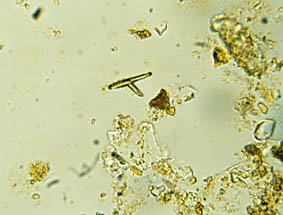
In England the most important ochre site was at Shotover hill near Oxford. It was known at least as early as the seventeenth century, and the site and the pits in the surrounding villages were worked continuously until the 1920s. Oxford carts were frequently painted yellow and the pigment is reputed to have even been exported to China. According to Hurst, Oxford ochre was the brightest of English ochres and was a ‘bright brownish-yellow colour’. The name ‘Oxford ochre’ seems to have been first used at the beginning of the nineteenth century, and it probably then referred to natural ochre mined in the region. However, by the beginning of the twentieth century at least one major colourman was substituting Mars yellow in paints marked ‘Oxford ochre’.

Notice the typical small particles and the agglomerates.
As the best quality ochre is worked out in one region another area becomes important. In 1924 Cruikshank Smith commented on the fact that the best Italian ochres are ‘voluminous in texture, finely powdered, of a dark, rich colour, and possess considerable staining power’; but by the mid fifties the OCCA manual Pigments, Dyestuffs and Lakes is more in favour of South African ochres, and says of Italian ones that their ‘texture is not good, and levigation is essential to remove the gritty impurities’.
In England during the nineteenth and the first part of the twentieth century, a great deal of ochre was mined in open-cast workings, but it was also found in deep mines that were being worked for other minerals, and was often washed and sold as a by-product. At the Devon Great Consols mine for example, the ochre was run through a series of settling tanks down the side of the hill. In other mines it was dug out as a plastic red or yellow coloured mineral. The amount of ochre produced by individual mines was usually small, but the annual production for the region which included Devon, Cornwall and the Mendips could be as much as 7000 tons [H.M.S.O.].
Ochre from different sites varies in colour and staining ability. Under the microscope the browner sorts can often be seen to be a mixture of red and yellow forms of ochre, others can be distinguished by the size of the particles, the form of the rods, or the proportion of quartz that is present. Dossie points out that the colour of yellow ochre was of ‘moderate brightness’ but that it was often brightened artificially with the addition of Dutch pink. More recently ochres for commercial paints were adulterated with chrome yellow.
Today France produces much of the ochre which is consumed, and the best region is in the Department of Vaucluse. The ochres are graded by coded initials.
J. C. (Jaune commune): consists of residual silica and clay tinted with stronger coloured pigment.
J.F.L. (Jaune foncé lavé): the lowest grade of levigated ochre.
J.F.L.S. (Jaune foncé lavé surfin): a better grade. Cruickshank Smith suggested that this is the lowest grade that it was profitable to use in making paint.
J.F.L.E.S. (Jaune foncé lavé extra-surfin): a still better grade prepared from picked parcels of crude ochre.
Other initials are used in which R for rouge and C for clair are substituted in appropriate places.
Yellow ochre is permanent to light and is not affected by alkaline solutions or dilute acids. If it is heated it will lose water and turn into red ochre. The longer the exposure to the heat and the higher the temperature, the darker the red produced. The amount of oil which an ochre will require depends not only on the colouring matter but also on the amount and type of impurities present. Poor quality ochres containing a considerable quantity of silica may require as little as 25% by weight of oil to be added, but a very pure one may need as much as 87%. Yellow ochre is not a good dryer, but the addition of a dryer in the form of manganese can cause the paint to dry darker than it would otherwise have done [J. C. Smith].
Lead tin yellow
Massicot, masticote
Lead tin oxide
All refractive indexes greater than 2.00
In Meltmount particles of lead tin yellow, which vary from less than 1 to about 3 micrometres, do not appear to be strongly coloured and it can be difficult to be sure that they are yellow if one is using an achromatic objective; they are usually clearly yellow if viewed with an apochromatic objective. The particles tend to have black edges because of their high relief. Between crossed polars, lines can be seen to move across some particles as the stage is rotated and they are likely to show only first order colours even in aggregates. The particles are noticeably larger than zinc or titanium white. The pigment can be easily distinguished from naples yellow because the latter is isotropic. It is not difficult to recognise this pigment in an almost pure sample, where it is known to have come from yellow paint. However, if present as a small component of a mixture it is easy to miss it.
Lead tin yellow can be prepared by heating lead monoxide and tin oxide to 600° C.
Before the last war there was considerable confusion about the yellow pigments that were in use prior to the middle of the eighteenth century. The yellows had been shown to contain lead, and for a long time it was believed that painters had used lead monoxide, despite the well-known fact that it was a very unstable colour. On the basis of her work with manuscript pigment recipes and references, Mrs Merrifield had realised that there were two lead based yellow pigments, but that usually the references could not be differentiated. Jaccopi working at the Doerner institute noticed that the spectroscopic readings for these ‘lead monoxides’ included tin, and as a result of a series of experiments he realised that many of the ‘lead yellows’ should have been called lead-tin yellow. He published his findings in 1941. Lead-tin yellow has now been recorded from easel paintings by Italian, German, and Flemish artists working between1300 and 1750, The authors have also found it on several seventeenth-century Flemish harpsichord soundboards. The pigment is now available from Kremer Pigmente. [Studies in Conservation H.Kühn, Lead-tin yellow, Vol 13 No 1 (1968) pp. 7-19]
Naples yellow
Solid yellow, antimony yellow
Lead antimoniate Pb3(SbO4)2
Refractive index 2.01-2.28
In plane polarised light, the colour of the particles can vary between pale and strong yellow. The individual particles can be of various shapes and may include ones with a convoluted surface, needle-like particles, pseudo-hexagonal plates and other crystal shapes. Aggregates of apparently fused, nearly circular masses of one micrometre particles are common. Though isotropic, when viewed between crossed polars some large particles and aggregates appear, a not very strong, white to yellowish white due to strain, and at a magnification of X 1000 undulose extinction has been seen [McCrone: The Particle Atlas]. Because of the high relief, edge depolarisation is marked. Most particles will show light edges with a dark centre when viewed between crossed polars, but particles with rough surfaces or made up of fused aggregates will remain a constant greyish colour as the stage is rotated. In some samples, possibly those that have been inadequately washed, colourless anisotropic particles with plane surfaces may outnumber the coloured isotropic ones. The colour, specific gravity and refractive index vary between samples and depend on the proportions of lead and antimony that have been used.
The pigment is prepared by heating, for about two hours, a mixture of oxides of lead and antimony, or the salts of these metals. The soluble salts are then washed out with water and the pigment is dried. The colour is affected by the relative amount of lead in the composition and also by the length of time the pigment is heated. Tingry makes the point that stirring the mass with a piece of soft iron imparted a more orange colour to the pigment.
Like most lead colours, the pigment is blackened by hydrogen sulphide. It is not affected by light, and is almost unaffected by alkalis or by nitric or hydrochloric acids. However, it is attacked by sulphuric acid. Most of the older authorities maintain that iron turns the pigment to a muddy green, and consequently, before the days of stainless steel, artists were advised to work it on their palettes with an ivory or horn spatula. Whether the discolouration was due to impurities and whether it was only some early samples that reacted in this way is not clear, but Doerner insists that working the pigment with a steel pallet knife does not affect the colour and the authors have been unable to change the colour of modern samples by leaving films of pigment, wetted out with oil or water, in contact with steel for two hours.
The colour of Naples yellow can vary from a light lemon yellow to orange yellow. In oil it has distinct brushing qualities, and excellent hiding power; it also dries well. According to Doerner, the pigment should not be ground thoroughly, and only needs to be lightly mixed with the oil.
The history of the pigment is obscure. Part of the difficulty probably arises from the fact that it was never used as a commercial paint, but was only made in small quantities for the use of artists. In a number of studies, made during the first half of the 20th century, naples yellow and lead tin yellow were confused: but it is now accepted that naples yellow can occur in works that were painted before 1600. Until the middle of the eighteenth century it was believed that the pigment was a natural earth or was volcanic in origin. There seems to be some doubt whether the pigment was ever manufactured in Naples. Fougeroux de Bondaroy, in a paper published in 1766, said that it was manufactured in Naples by only one man, and he goes on to give details of how it could be made. However, Laurie said, in a lecture given in 1891, that he had ‘failed to find either that it was made or anyone who had ever heard of its being made in Naples’. Because it is blackened by hydrogen sulphide, the pigment is not suitable for use in watercolour, which probably explains why, by the end of the nineteenth century, some colourmen were substituting a mixture of cadmium yellow and zinc white in both oils and watercolours, though they sold this mixture under the name ‘Naples yellow’. Church mentions another colour which was sold under the name jaune d’antimoine, despite its name the pigment did not contain antimony and was a mixture of the oxychlorides of bismuth and lead. Today, the genuine pigment is still sold by a few artists suppliers. The pigment was used by the early Egyptians to colour glass, and more recently it has been used to paint pottery and porcelain. A related colour, lead tin antimoniate, is still used to some extent in the ceramic industry.
Orpiment
Auripigmentum, Chinese yellow, yellow arsenic. Since the eighteenth century the name ‘king’s yellow’ has been used to refer to the synthetic varieties. In earlier literature the word ‘orpiment’ seems to have been used for both the natural mineral and the synthetic material.
Refractive index c. 2.4 – 2.8 Monoclinic
Arsenic tri-sulphide As2S3
Under the microscope, orpiment appears as yellow broken fragments. Because of its micaceous structure some of the particles are likely to show perfect cleavage planes while others, which are often elongated, will show parallel striations and appear pleochroic. Extinction is usually parallel to the striations, but can be oblique. The first and second order red interference colours are anomalous as they are a more ‘brick’ red colour than the standard Newton colours. A wide variation in sizes can occur but typically particles are in the 4 to 20 micrometre range. It is doubtful if sublimed king’s yellow can be distinguished from the natural mineral. However, dispersions of ground natural mineral orpiment prepared by the authors often include a number of particles which are covered, wholly or partly, with an opaque brownish crust, and this does not seem to occur in samples of paint taken from old works of fine and applied art. The pigment is usually a light yellow, but the ground mineral can be warmer if it includes a small amount of realgar, which often occurs with it. The precipitated variety of king’s yellow is difficult to identify with the microscope. The particles are usually very fine. They do not display pleochroism, but may have similar interference colours to the fine particles seen in natural orpiment.
Natural deposits of mineral orpiment, often associated with realgar, are found in various parts in Eastern Europe and Asia. Good samples only need to be ground to make them fit to use as a pigment. Orpiment can be synthesised by subliming a mixture of 20 parts of sulphur and one part arsenic oxide. As sulphur and arsenic are driven off when smelting iron from arsenetical pyrites orpiment tended to form as a by-product in the chimneys of the furnaces. This would explain why there are few accounts of the preparation of king’s yellow for use by painters [Zerr and Rubenkamp). Arsenic tri-sulphide can also be precipitated by passing hydrogen sulphide through a solution made by dissolving arsenic in hydrochloric acid, and as this produces very fine particles it may have been considered more suitable for use in watercolour. It seems likely that sublimation continued in use until the end of the nineteenth century as Hurst still gives details of this method in the 1892 edition of Painters’ Colours Oils, and Varnishes. However, the edition that was revised by Noel Heaton in 1913 does not mention king’s yellow. The authors have found what must have been natural or sublimed orpiment in restorations made shortly before 1900. The precipitation process seems to have been available only during the nineteenth century and never seems to have been as popular as sublimation.

When exposed to wavelengths of between c. 500 and 670nm any realgar in the pigment converts to para-realgar, and the colour changes from a warm yellow to the slightly cool yellow that is typical of orpiment. There is some evidence that over long periods orpiment attacks paint binders causing them to disintegrate, and the paint may be converted to a yellow poisonous dust. The pigment is not affected by organic solvents, alkalis or dilute acids, but it dissolves in strong acids. Orpiment cannot be used in mixtures with lead white or with copper pigments. The dust, which occurs during dry grinding, and the gas which is given off by dry orpiment and which is increased if the orpiment is damp or mixed with oil, are extremely poisonous.
Orpiment is a fine yellow ‘less crude than the chromes’ [Reeves]. It has little staining power, but covers well, and the pigment was probably not ground too finely to preserve its colour. It is a poor dryer; ‘according to de Mayerne, Cornelius Johnson recommended that orpiment should be ground in oil previously boiled with litharge’ [Harley].
The natural mineral was used in Classical times, and the authors have found it on an Egyptian sarcophagus mixed with Egyptian blue to form a green. Cennini, writing in the fifteenth century, says that it was prepared by alchemists. He comments on the fact that one of the few colours it could be mixed with was indigo. In the eighteenth century Dossie said that painters used the artificially prepared king’s yellow and that the natural mineral was used only for such mundane functions as painting the rush seats of chairs. (It may have been used for this purpose as much to discourage bugs as for its colour.) Orpiment was employed by manuscript illuminators and heraldic painters. Its most frequent use in the fine-art world was when gold needed to be represented in paint. De Wild did not find it in seventeenth century Dutch or Flemish paintings. It seems possible that it was used to a greater extent outside the field of fine art. Moxton mentions its use in printing ink, and the authors have found it, mixed with lamp black, in the green printing ink on the decorative lid papers of seventeenth-century Flemish harpsichords and in the case decorations of Italian and English harpsichords. In the Painter and Glaziers’ Guide Nathaniel Whittock points out that ‘it is a bright opaque colour but must be used by itself, as if it is mixed with any mineral colour it flies instantly’. G. A. Smeaton, who wrote the Painter’s Gilder’s and Varnisher’s Manual which probably first appeared in the 1830s, says ‘It is good for some purposes, particularly for the production of straw colours in painting doors, windows &c’. Orpiment was an important pigment in the East.
Winsor & Newton listed king’s yellow at one shilling [5p] for a whole cake in 1868; in 1889 it was only available in oil, and in neither year was it available as a dry colour. It was no longer listed in 1928 [Leslie Carlyle]. Orpiment is no longer sold as a colour in the U. K. and watercolours offered under the name of king’s yellow during the 20th century were likely to have been composed of zinc white mixed with cadmium yellow or chrome yellow [Hiler].
Realgar
Red orpiment, sandarack
Arsenic sulphide, AsS. Pararealgar is likely to be present as well.
Refractive index 2.538 – 2.714. The refractive index for realgar glass is 1.88
As a pigment, realgar is unusual in that the features that can be observed change with the condition of the sample. For further information on pararealgar see Corbeil, M. C, and Helwig, K. An occurrence of pararealgar as an original or altered artists’ pigment. Studies in Conservation Vol 40 No 2 pp 133-138.
When viewed in plane polarised light, particles that have a regular crystalline structure are transparent and pleochroic changing from acid to warm yellow as the stage is rotated. Cleavage surfaces are frequent. The particles tend to show irregular lines and spots (sometimes rather like a finger print), which are probably fissures in the surface, but could be gas inclusions. Between crossed polars the colours are anomalous; blue or blue-green may replace first order grey or white, and first order red may not appear at all. This makes it sound somewhat similar to red lead, but red lead lacks the acid yellow pleochroism and red lead particles that have a blue or green interference colour tend to be minute, whereas the particles that show anomalous colours in realgar can be as much as 8 micrometres, and only very substantial particles appear orange. While this is typical of the freshly broken mineral, one is most unlikely to see this combination of features in paint of any age. Realgar was sometimes melted to form a glass and then used as a melt to provide a high refractive index mountant when mounting diatoms.
Almost all samples found in paint will have begun to change to pararealgar, though in plane polarised light such material may still have the colour and fingerprint fissures of crystalline realgar, other particles can appear to be covered with a fine powder or have a roughened surface. Between crossed polars the particles that have begun to convert to pararealgar tend to give out a characteristic diffuse brownish-orange glow, and the effect is not affected by the size of the particle. Mixtures of crystalline particles and ones showing this uniform colour can occur, but usually all the particles in a sample produce the same effect between crossed polars. According to Hurst, realgar was synthesised by subliming a mixture of sulphur and arsenic oxide, melting the sublimate, and then grinding the mass. This could explain why particles in some samples contain gas bubbles and others show ‘nibbled’ edges where the break passes through a bubble. These particles show the same effect between crossed polars as realgar from other sources that have begun to convert to pararealgar.
When exposed to light between c. 500 and 670nm, realgar tends to convert to pararealgar. Chinese carvings in realgar have crumbled to a yellow dust in museum conditions, and it is this change in crystalline structure that accounts for the optical changes given above. When painted out in watercolour the best realgar, which is a fine red colour in the mass, appears as a beautiful luminous yellow brown, but samples that have begun to convert to pararealgar can appear a warm yellow.
Natural realgar is found in many parts of the world, usually in association with orpiment. It is this natural form , rather than the synthetic variety mentioned by Hurst that was probably used in the orient and during the classical period. Little has been written about the use of realgar as a pigment, but it is likely to be as incompatible with other pigments as orpiment.
Realgar was known in classical times when it was called sandarak but it seems to have been often confused with red lead [G&S]. It has been recorded from the eleventh- to twelfth-century wall paintings from Kara Khoto in Central Asia. It has been used extensively in the East and may be found in Indian and Arabic miniatures, but it does not seem to have been used anything like as much as orpiment in the West. It has been suggested that realgar is responsible for many of the luminous browns found in English and Dutch paintings of the seventeenth and eighteenth centuries, and has been identified in an eighteenth century English pastel portrait. We have found it in the soundboard painting of an early eighteenth-century English harpsichord and also in some marbled papers used as drawer linings. Its continued use in nineteenth-century England is attested by a watercolour cake by Newman described as ‘red orpiment’, which is now a bright yellow colour. We have also a cake, unfortunately without a manufacturers name, of a typical orange brown colour where the pigment has clearly been prepared by sublimation and melting.
Turner’s yellow
Turner’s yellow, also known as patent yellow, Montpellier yellow, Cassel yellow, Verona yellow, mineral yellow etc.
Lead oxychloride
Refractive indexes greater than 1.80
In plane polarised light the particles appear as very pale yellow fragments with good relief and distinct cleavage planes. Small particles appear colourless. The yellow particles are not noticeably pleochroic. Between crossed polars, the interference colours of some large particles can be anomalous; the first order grey being replaced by blue, but a number of samples have been found in which none or only very few, of the particles show anomalous colours. Because of the excellent cleavage, the extinction is usually parallel or symmetrical, but most of the particles are likely to appear isotropic due to their lying perpendicularly to the optic axis. Particles have been noticed which show a ‘cross-hatched’ twinning between crossed polars and which is rather like that shown by microline feldspar. A few particles may show striations.
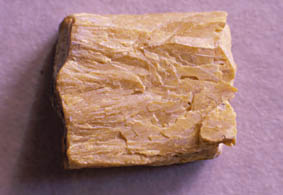
The pigment was prepared by first making lead chloride by mixing litharge and salt with water, washing the product to free it from the sodium hydoxide, and then calcining it at a temperature just high enough to melt the mass. The colour which ranged from a light greenish yellow to a dark orange yellow depended on the temperature and the length of time the pigment was heated. There are several oxychlorides of lead, all of which show excellent cleavage and which are yellow or white in colour. It seems possible that at least some samples of the pigment may include more than one of them.
The pigment was discovered by Scheele about 1770 and patented in England by James Turner in 1781. There is an indication that it was manufactured at Walker-upon-Tyne and was sold as Turner’s patent yellow [Harley]. C. Chaptal established a manufactory for the colour in Montpellier. It has been stated that samples of the patent yellow were shown in the 1851 Exhibition by the Washington Chemical Company of Washington County Durham. The Washington Chemical works did show an oxychloride, but it was Pattinson’s patent white oxychoride of led, Patent No 13519 dated 18 Feb 1851 [1851 Catalogue, Woodcraft].

and what appear to be striations
The authors have seen a sample of Turners yellow that came from a wheelwright’s shop and which is now in Hertford Museum. It was in the form of heavy, easily broken lumps which were dark on the outside, but bright yellow inside, there were distinct parallel striations. The pieces were rather more than 1 cm thick and it was apparently intended that the painter should grind these himself. In another sample, which came from an amateur painter, the pigment was in the form of a fine powder of a very pale yellow colour.
Field says that this pigment ‘has an excellent body, and works well in oil and water, but is soon injured by the sun’s light and impure air; it is therefore little used, except for the common purposes of house-painting …’ It was used in the decoration of Brighton Pavilion. Smeaton makes the comment that it is ‘a very beautiful colour, and much in use among coach-painters.’ However, there are indications that Constable may have used the pigment for in a letter he says ‘for the height of the sun he [the artist] has but patent yellow and lead white’ [Completing the Picture]. In view of its lead content, the colour is likely to have been a good dryer, but the lead will also have made it particularly vulnerable to sulphur when used in watercolour. Despite this it was offered by Ackermann at one shilling a cake [Harley].

It is not clear when the colour ceased to be made, but Hurst, writing in 1904, comments that the colour was ‘at one time largely used; but since the introduction of the chrome yellows it has been gradually, and, perhaps, entirely abandoned’. That it was obsolete by the beginning of the twentieth century is confirmed by the English edition by Dr Charles Mayer of Zerr and Rübencamp’s Treatise on Colour Manufacture where it is stated that the pigment is ‘… probably not to be found in commerce at all now.’
Yellow lakes
The authors have found yellow lakes on chalk, blanc fixe, and starch, but see lake bases for a list of other bases that have been used. The traditional natural dyestuff that was used until the early nineteenth century was Persian berries or quercitron. The yellow lake made from quercitron bark was often called Dutch pink. (‘Pink’ in this context meaning ‘lake’.) The low cost of chrome yellow made the production of yellow lakes largely uneconomic during much of the nineteenth and twentieth centuries. However, azo dyes could be used to produce good quality yellow of equal brightness to the chromes. Yellow dyestuffs were mainly used to modify the colour of greens.
In 1920 F. H. Jennison wrote that, ‘The two principal basic yellow colours are Auramine, a diphenyl-methane colour, and Thioflavine T, a thiophenyl colour. There are numerous acid yellows, of which Naphthol Yellow S, Metanil Yellow, Quinoline Yellow , and Tartrazine, a hydrazine xylene yellow (of Sandoz) colour are the most useful for lake production. Napthol Yellow S gives a lake very fast to light but which is soluble in water to a considerable extent and can readily be detected when present in a lake by the solution it gives with hot water. Metanil Yellow has the same fault but to a lesser degree. Tartrazine gives deeper shades which, however, are fairly fast to light. Quinoline Yellow and Xylene Yellow give good lakes of a very pure tone, the Xylene Yellow producing if anything the better pigment.’
‘Auramine gives a very good lake on blanc-fixe, suitable for use in surface paper-work in place of lemon chrome, where it is essential that the colouring-matter used should be lead-free. … The two basic yellows, Auramine and Thioflavine T, are both used in the production of greens from purely basic dyestuffs, the Auramine giving a myrtle shade, the Thioflavine T the purer shade, but the latter is much the more expensive.’ [Manufacture of Lake Pigments from Artificial Colours p. 102, 2nd Ed, 1920]
Mactaggart, P. & Mactaggart, A. (June 2007) ‘Yellow Pigments’ In: Pigment ID using Polarised Light Microscopy from: https://academicprojects.co.uk/yellow-pigments/
