

Please see below details for Aerinite, Ultramarine, Azurite, Blue verditer, Cerulean blue, Cobalt blue, Egyptian blue, Indigo, Manganese blue, Maya blue, Phthalocyanine blue, Prussian blue, Smalt, Verdigris and Vivianite.
Aerinite
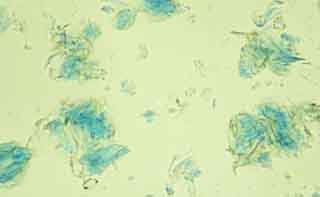
Under the polarising microscope, particles from the only sample of the pigment the authors have examined appeared to be made up of length-fast undulating fibres. They were light greenish blue in colour and slightly pleochroic, mainly changing from a stronger blue to a weaker one. On small particles this was best seen by rotating the polariser rather than the stage. The pigment appeared green with the Chelsea filter. The relief was low and the refractive index less than 1.66. Between crossed polars most particles took on an anomalous polarisation colour which is a bronzy yellow – this appears to be the most obvious distinguishing feature of the pigment.
Aerinite is a natural blue clay which is found in Spain. It has been recorded from Romanesque frescoes that were found in chapels in the Catalan Pyrenees and from Andorra where the earliest example dates from 1163 (Palet Casas, A. and Jaime de Andrés Llopis, The identification of aerinite as a blue pigment in the Romanesque frescoes of the Pyrenean region, Studies in Conservation, Vol 37 No 21 May 1992 pp.132-137) .
Winchell refers to aerinite as a ferriferous chlorite. In addition he says that the X axis is nearly normal to the plane of perfect cleavage. Light vibrating parallel to the X axis is yellow or colourless, while that vibrating in the plane of the Y and Z axes is dark cobalt blue. If most of the particles lie with their X axis normal to the stage due to cleavage this would explain why only a slight change in blue colour can be seen (Winchell, A. N. Elements of Optical Mineralogy Pt II, 3rd Edn. 1933, p. 285.). Gettens and Stout suggested that aerinite was a constituent of Maya blue. this is now known to be untrue (Gettens, R. J. and Stout, G. L. Painting Materials a Short Encyclopaedia 1966. pp. 130).
Ultramarine
The artificial variety was known as French ultramarine, French blue, Guimet’s blue, New blue, Permanent blue, synthetic or artificial ultramarine. The name ‘lime blue’ was sometimes misapplied to the lower grades extended with gypsum because these were used to tint lime washes and distempers. The name yellow ultramarine was sometimes applied to barium chromate. Ultramarine ash is the name applied to the palest grade of genuine ultramarine.
Artificial ultramarine Na6-10Al6Si6O24S2-4
Lazurite is the mineral responsible for the blue colour in genuine ultramarine 3Na2O . 3Al2O3 . 6SiO2 . 2Na2S but a number of colourless related minerals are always present.
Refractive index c.1.5, cubic.
Samples of artificial ultramarine are composed of particles of uniform deep blue colour, and in most modern samples the size is rather small. However, in older samples small and large particles could be found together. Natural or genuine ultramarine is prepared from lapis lazuli which is a rock and is made up from a number of related minerals, only one, lazurite, is strongly blue but all are isotropic. Under the microscope genuine ultramarine appears as broken fragments, often with conchoidal fractures, and exhibiting a wide range of particle sizes. The colour of particles can vary from almost white to a fine deep blue, but differences in colour need not be related to the size or thickness of the particles. The blue particles usually appear to be more transparent than those found in the artificial pigment. Both forms are isotropic although calcite and possibly other birefringent minerals, are likely to be present with the natural variety, and may occur joined to blue fragments thus making the blue particle appear doubly refracting. One may also find occasional blue particles in genuine ultramarine that appear anisotropic between crossed polars due to strain. Artificial ultramarine is usually very finely ground, but it can occur in the form of coarse particles and in this case it will be found that the artificial pigment appears uniformly coloured and more opaque than the natural pigment. Both natural and artificial forms have good relief in Meltmount. Blue particles appear to be a strong red when illuminated through the Chelsea filter; the red of artificial ultramarine tends to be brighter than that of the natural material. The size of the particles found in artificial ultramarine usually ranges from 0.5 to 5 micrometre and this is the size that is normally supplied to artists and which was used in distempers, but coarser material was sold during the nineteenth century and this can include particles as large as 25 micrometres. In paint, fragments of the natural mineral can exceed 30 micrometres. Descriptions of genuine ultramarine and smalt can make the pigments appear to be similar, as both are likely to include many colourless and coloured particles which show conchoidal fractures. Both appear red with the Chelsea filter and are isotropic. However, the bluest particles in ultramarine are likely to be a much stronger colour than any that will be found in smalt and it will be found that small particles of ultramarine can be a very good blue, while small particles of smalt are never as strongly coloured. The red colour with the Chelsea filter is also much stronger in ultramarine than in smalt, and particles of smalt are likely to show thinner edges and more marked conchoidal fractures than will be found in ultramarine.
Natural ultramarine is prepared from ground lapis lazuli: a rock which contains among other minerals, lazurite, sodalite, pyrites and calcite. Early examples of he pigment appear to have bee produced my merely grinding the rock, but since the sixteenth century, the pigment has been prepared by incorporating the powdered lapis lazuli into a paste made of wax, resin and oil, and kneading the mass in a weak solution of lye. Because the lazurite (blue) particles are preferentially wetted they tend to come out fist. Successive kneading yield paler grades of colour. Finally the ball is calcined and the resulting pale blue material is sold as ultramarine ash.
Artificial ultramarine was first prepared by Guimet who received a prize for his discovery in 1828. He set up a factory for its production in 1830. The artificial pigment is a furnace product prepared by heating the following iron-free ingredients in a closed crucible at red heat: anhydrous sodium sulphate and/or carbonate, china clay, sand, and sulphur. Some form of carbon is added to ensure a reducing atmosphere. The process is a slow one according to the Introduction to Paint Technology Published by the Oil and Colour Chemist’s Association “The heating operation takes five days and the fires are then drawn and the furnace allowed to cool during a period of 25 days.” The soluble salts are washed out. By variations in the ingredients and process, ultramarine pigments of many hues such as turquoise, pink and violet can be produced, but they are not widely used in painting. Samples of these colours the authors have seen appear, under the microscope, like broken fragments from clinker.
Ultramarine is a reasonably stable pigment, but it is decolourised by acids – even weak ones. This occurs less rapidly with the natural mineral than the artificial pigment and Joyce Plesters has suggested that the time taken for a sample to decolourise can be used to distinguish between the artificial and genuine ultramarine. However, the difference in time may be at least partly due to the smaller particle size of most samples of artificial ultramarine, and the consequent relatively larger surface area. The sensitivity to acid is such that blue printing ink made of ultramarine could not be used for posters in manufacturing areas where the air was polluted with sulphur dioxide. The pigment is not affected by heat.
Ultramarine is used by textile, letterpress and lithographic printers. It replaced smalt as washing blue and Zerr and Rübencamp say that it was not only used to whiten linen, but also the chalk and lye used for whitewash, paper pulp, soap, starch, barytes and even fats and sugar. The use of ultramarine in this way may explain why a few particles are often found in samples from 19th and 20th century paint where, on the basis of the colour, blue would not have been expected.
Ultramarine does not work well in oil and tends to form stringy pastes; as a result, waxes and other stabilizers are often added to improve the handling qualities of the paint. It also had a tendency to settle in a hard mass at the bottom of the tin, and sometimes to separate, after application, from pigments with which it had been mixed, so that streaks form as the work dries. Ultramarine is semi transparent in oil and, according to Cruickshank Smith, it was commercial practice to add a small amount of Paris white [chalk] or terra alba [gypsum] to the paint where good covering power was required. He adds that ‘Ultramarine paint used by coach painters is always employed as an undercoating (that is, in a flat or semi-flat form) which is afterwards varnished. Undercoatings containing ultramarine posess a marked tendency to absorb the varnish applied over them owing to their porosity.’ Because of its tolerance of alkaline conditions it was used extensively for washable water paints and distempers. Another way of using it is mentioned by Heaton. He says that it was ‘used extensively as a glaze over body colour’; used in this way the modern craftsmen were following the early masters who used genuine ultramarine as a glaze over an azurite underpainting.
Ground lapis has been found in wall paintings in caves in Afghanistan that were painted during the 6th and 7th centuries. It has been found in an illuminated manuscript where the robes of the patron saint were painted in lapis, but those of the abbot were painted with indigo. Ground lapis does not produce a good colour, but this dull blue was used on Persian miniatures until the 15th century when it was replaced with the refined material we know as ultramarine. This may have been imported from Europe where the technique of refining had been developed during the 12th and 13th centuries. Ultramarine was always a very expensive pigment and it was usually used only in small or relatively small quantities. However, it has been found used freely in wall decorations on the ruined walls of the abbey at Glastonbury, but it is likely that its use on easel paintings during the Italian Renaissance was confined to very important commissions where its cost was often stated separately.
In 1885 Winsor and Newton were offering French (artificial) ultramarine from 1/- (one shilling) to 3/- per ounce, and genuine ultramarine from two to seven guineas; two grades of ultramarine ash were listed, priced at 16/- (sixteen shillings), and one pound four shillings. In the 1980s a dram (about 2 grams) of grade-two genuine ultramarine cost the authors about £20.00. The wars in Afghanistan have meant that very little genuine ultramarine has been made recently.
Azurite
Mountain blue, Bergblau, bleu de montagne, bleu d’Allemagne, azzurro della magna, lapis armenius, bice (N.B. the term bice was used for other blues as well as azurite.) Colour index CI Pigment Blue 30.
Natural basic copper carbonate. 2CuCO3 . Cu(OH)2
Monoclinic; refractive index 1.73-1.84
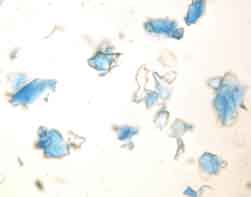
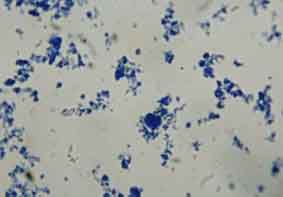
In Meltmount particles of 5-40 micrometres are a fine blue, but very small particles may not show colour. Fragments tend to be angular and some particles may show conchoidal fractures, but a number of particles are likely to show flat tops caused by cleavage. The pigment is strongly birefringent – second order colours are likely to be seen in quite small particles – and the extinction is distinct. Some particles are likely to show pleochroism: violet blue to greenish blue. Particles do not show red under the Chelsea filter, but some may show a warm grey in the violet blue position. Small quantities of cuprite, a reddish-orange isotropic copper oxide and malachite are sometimes found as impurities. Because of azurite’s high birefringence and the fact that some particles may almost twinkle, there is a chance of mistaking small colourless particles of azurite for calcite. However, the two materials can easily be distinguished because in the position of high relief, azurite has a noticeably higher refractive index than 1.66, while calcite is lower, in addition one might see symmetrical extinction in particles of calcite.
Azurite is an important copper ore which occurs in many parts of the world. It is often associated with malachite, which is a more stable copper carbonate. After mining the pigment is prepared by selecting, grinding, levigation and washing. Honey or gum arabic was often added to the water used for levigation, this ensured that very small particles and light dross remained suspended while the bulk of the azurite sank. Clean water would then be used for washing. Pigment from fineley ground azurite is pale in colour, while more coarsly ground material is noticeably darker. It is blackened by warm alkalies, and dissolved by weak acids, but it is stable in all normal conditions.
There is some evidence that during the 16th and 17th centuries, azurite came largely from Hungary, but this source became less important due to the Turkish invasions of that country which started in the middle of the sixteenth century. It appears to have been imported from central America during the seventeenth century and may have also come from Chessy in France where it is still mined (Harley, R. D. Artists’ Pigments c. 1600—1835 2nd Edn 1982 p. 47).
Azurite was used in Italy and Northern Europe between the fourteenth and seventeenth centuries in oil, egg tempera, fresco and watercolour. According to Daniel Thompson, it occurs in many illuminated manuscripts. The writers have found it occasionally on seventeenth century harpsichord soundboards. Azurite was seldom used in the West after the middle of the 17th century, but it remained an important pigment in the east. In China it was employed in the cave temples at Tun Huang in Western China and was used in wall painting during the Sung and Ming dynasties. It was one of the ancient pigments of Japan and was still used by Japanese artists after the last war. It was used by the Egyptians, but Gettens and Stout do not know of a Roman painting where it has been identified, and suggest that this lack of popularity may have been due to the ready availability of Egyptian blue (Gettens, R. J. and Stout, G. L. Painting Materials a Short Encyclopaedia 1966. pp. 95-96). Azurite occurs in Arabic manuscripts, sometimes mixed with genuine ultramarine (Baker, D. Private communication).
In oil, azurite has relatively little covering power, but it can be used successfully in watercolour. Painters used the various grades of the pigment as colours in their own right. This is illustrated by the four grades of azurite that were supplied to Alexander Chalmer in 1506 for painting the king’s ship; they ranged from 1 oz at ten shillings per oz, to 16 oz at five shillings per oz, the prices are in shillings Scots, the value of which fluctuated, but a Scots shilling was usually worth substantially less than and English one at the same period (Apted, M. R. and Hannabuss, S. Painters in Scotland 1301-1700 p. 131). Harley quotes a price of six shillings and eight pence per pound in England in 1582 (Harley, R. D. Artists’ Pigments c. 1600-1835 2nd Edn 1982 p. 47).
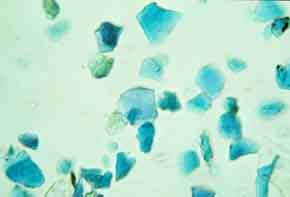
There is a slightly violet particle near the centre, but most of the particles are a greenish blue. (The green particles
are malachite.) Conchoidal fracture and cleavage are visible.
Blue verditer
Although quite different in appearance, blue verditer has the same chemical composition as azurite.
The refractive index is about 1.72. In Meltmount the pigment appears as small rounded blue or greenish-blue particles or as larger, irregularly-shaped greenish blue aggregates often with a central dark spot. It is strongly birefringent but not pleochroic. It does not appear red under the Chelsea filter. The individual particles can vary in size from about 2 to 5 micrometres but masses may be in excess of 40 micrometres. Very small particles are almost colourless, masses are usually a good greenish-blue, but some achromatic lenses tend to exaggerate the greenish quality of the particles, and some people are apt to mistake this pigment under the microscope for a green. The extinction has been described as ‘cauliflower’ – between crossed polars, aggregates do not extinguish but irregular dark lines may move across their surface as the stage is rotated. In small rounded particles a stationary cross of brushes similar to a biaxial interference figure may sometimes be seen. If a red plate is used when viewing particles or aggregates between crossed polars, it will be seen that, in most samples, they are made up of tiny rods, which are normally fast length. In one sample rods were largely absent and the crystals were arranged similarly to green verditer. In one old watercolour cake of blue verditer, crystals of cuprite were found.
Blue verditer is an artificially prepared copper carbonate with the same composition as azurite. Its preparation seems to have been something of an English speciality and the true pigment was made by stirring chalk in a solution of copper nitrate (Mactaggart, P, and R. A. Refiners’ verditer. Studies in Conservation Vol 25 No 1, pp. 37-45). It only forms if the temperature is low, and no sulphate compound is present. If the stirring is insufficient to stop the water becoming charged with carbon dioxide, a green material which does not make a satisfactory pigment and is similar to the mineral called gerhardtite is produced. Blue verditer was originally prepared as a byproduct of silver refining, but when, towards the end of the eighteenth century, the refiners changed from using nitric acid to sulphuric acid they could no longer make the pigment. A few refiners may have continued to use nitric acid, or may have produced blue verditer specially during the nineteenth century. Many recipes that purport to describe other ways of making blue verditer were published during the eighteenth and nineteenth centuries. Most of these produce copper ammonium compounds, and although a number of these produce pale blue materials, none of them are as stable as the genuine pigment.
Blue verditer came into general use in the early part of the 17th century, although it is just possible that the numerous references to ‘silver blue’ in the previous centuries indicate that it was made much earlier. It was probably at the height of its popularity at the end of the seventeenth and the beginning of the eighteenth centuries, when pigment of excellent colour and large particle size was produced. Its use in painting declined after the discovery of prussian blue, but it was still used to colour wallpaper at the end of the eighteenth century, by which time only the small particle size pigment seems to have been available, and in two instances it had been mixed with chalk, this would have reduced the intensity of the colour without making it pastel. On English blue japanned furniture it was sometimes used to underpaint smalt. Watercolour cakes of blue verditer were still available during the nineteenth century. In Rowney’s 1851 catalogue a cake was priced at one shilling.
Microscopically Green verditer is very similar to blue verditer in appearance. It only occurs in the small form and the particles are often somewhat distorted. With crossed polars and the red plate it will be seen that instead of being made up of very small short rods, green verditer is composed of two or three crystals arranged in various orientations.

Cerulean blue
Bleu celest
Cobaltous stannate CoO . nSnO2 Cubic, Refractive index c. 1.84
In Meltmount cerulean blue appears as small, isotropic greenish-blue particles with rounded shapes, many of which also have rounded excrescences and may look rather like small pieces of root ginger. Individual 1 to 3 micrometre particles are a pale blue, but 10 to 20 micrometre fused agglomerates have quite a strong colour. With the Chelsea filter the most strongly coloured particles and aggregates may appear pink. Strongly birefringent colourless particles have been noticed in some samples.
The pigment is prepared by precipitating cobaltous chloride with potassium stannate, mixing this with silica and calcium sulphate, and then heating the mixture to red heat (Gettens, R. J. and Stout, G. L. Painting Materials a Short Encyclopaedia 1966. pp. 103). It is an expensive colour, but like most furnace products has the advantage that it is not affected by light or strong chemicals.
The compound was known from the early 19th century, but was first introduced as an artist’s pigment by George Rowney: Gettens and Stout say that date was 1860, but Mayer gives it as 1870 (Mayer, R. The Artists Handbook of Materials and Techniques Edit. Smith, Edwin 3rd ed 1973, p. 46). In 1887 the author of a Winsor and Newton publication was hardly enthusiastic about the pigment; he comments:- “By daylight it is a light greenish-grey blue with little depth or richness of colour. Unless used with care it is apt to produce a chalky effect, and it washes in a very indifferent manner” (Taylor, J. Scott, Modern Water-Colour Pigments 1887, p. 58). Cerulean blue is used in both oil and watercolour, it covers well but is not strongly staining. It suffers less from metameric effects than the other cobalt blues.
Cobalt Blue
Colour index: Pigment blue 28
Gahn’s ultramarine, Thenard’s blue, cobalt ultramarine, azure blue
CoO . Al2O3 Refractive index, normally, c. 1.69
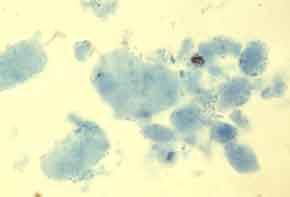
Cobalt blue is a mineraloid with a variable composition and refractive index. n is usually about 1.69, (McCrone, W. C. et all, The Particle Atlas 2nd Ed. Vol V 1979, p. 1316.) but rare samples have been found where the refractive index has either been less than 1.66 or about 1.72. The particles in most samples are isotropic, have low relief and a refractive index slightly greater than Meltmount. However, it will be noticed that the relief varies between different particles. The larger particles are usually rounded with a rough or crusty textured surface, and appear red under the Chelsea filter. Smaller particles may have a low relief, but some often have higher relief and may appear a more greenish blue. The size can vary from about 2 to over 20 micrometres. Almost all samples, old or new are of this type, but in one modern sample, from Lefranc & Bougeois, most of the larger particles had an unusually high relief, these included some particles that appeared to be parts of hexagonal basal plates and others that were unusually transparent and showed crystal faces; many of these particles were anisotropic and had a refractive index of c. 1.72. Some of the small particles in this sample had the usual low relief. Lower than usual refractive indexes have also been found. McCrone mentioned to the authors during a microscope conference that he had found isotropic cobalt blue in two paintings by Manet with a refractive index that was less than 1.66.
Today the pigment is regarded as being extremely stable, although some early samples are know to have turned black. Cobalt blue is normally prepared by calcining together cobalt oxide and aluminium hydrate for about half an hour, but the original Thénard blue is said to have been prepared using cobalt phosphate. The colour of this pigment varies slightly depending on the impurities present and the method of preparation (Gettens, R. J. and Stout, G. L. Painting Materials a Short Encyclopaedia 1966. pp. 95-96). Cobalt blue exhibits noticeable metamerism, appearing more violet when viewed in tungsten light.
Cobalt blue was first recommended as an artist’s pigment by Thénard in 1802 and had become a branch of commerce by 1807 (Harley, R. D., Artists’ Pigments c.1600-1835, 2 Ed. 1982, p. 56).
It seems to have been available in England by about 1815. It was recommended by Varley in 1816, and used in watercolours by Bonington (1802-28). It was always one of the most expensive artists pigments – both Roberson and Rowney offered it at two shillings for a whole cake in 1851 and Winsor & Newton list it at four shillings and six pence an ounce in 1889. It is too expensive to be used in commercial paints, and in these and in cheap artist’s and student colours, cobalt shades are usually imitated with artificial ultramarine or sometimes a blue lake.
Its covering power both in oil and watercolour is low. In watercolour it washes and handles well – much better than artificial ultramarine.
Egyptian Blue
Pompeian blue, Vestorian blue.
Calcium copper silicate CaCuSi4O10
Uniaxial: omega 1.635, epsilon 1.605: optically negative.
In Meltmount Egyptian blue appears as delicate greyish blue broken particles which are often in the form of thin flakes, and which sometimes contain gas bubbles. The relief is low. Though pleochroic this feature is often difficult to see, and the thin flakes tend to show only weak birefringence. The fact that the particles are anisotropic can sometimes be made more obvious if a red plate is used between crossed polars. Under the Chelsea filter the more strongly coloured particles may appear pink.
This pigment was used by the Egyptians and Romans from before 1500 BC, and continued in use at least until the ninth century. Some time after that period the method of making it was lost, for although Vitruvius (VII Chap XI) gives the constituents he did not explain the method of manufacture. There were a number of attempts to make Egyptian blue during the eighteenth and nineteenth centuries. Some of these were successful, and in 1893 Vestorian blue was exhibited at the World Fair in Chicago. However, it was not until Laurie et al carried out an extensive series of experiments in 1914 that the process was understood (A. P. Laurie et al, ‘Egyptian Blue’, Proceedings of the Royal Society of London, Series A, Vol LXXXIX, 1914 pp. 418-429). Chaptal did not think that the pigment was crystalline and believed that it was a frit, and this mistaken view has been repeated more recently.
Egyptian blue was prepared by heating for a considerable time a copper compound (probably malachite) with silica, calcium carbonate, and sodium sesquicarbonate (natron). The temperature is critical and the mixture needs to be maintained between 800° and 900°C — ideally about 830°C. It is not difficult to hold a temperature between narrow bands now that we have electric kilns and thermostats, but we do not know how the pigment makers in classical times managed to do so, or whether, as has been suggested, they heated and then re-heated the blue a number of times (Riederer Josef, Egyptian Blue, Artists’ Pigments, A handbook of Their History and Characteristics Vol 3, Ed. Elizabeth West Fitzhugh, 1997, pp. 23-40).
Somewhat similar man-made blue and purple pigments have been found on a few Chinese objects from the Han dynasty (208 BC-AD 220). They are barium copper silicates (BaCuSi4O10 – blue, and BaCuSi2O6 – purple) and it has been suggested that they should be called Han blue or Han purple depending on the actual colour. They are prepared in a similar way to Egyptian blue, but the temperature is less critical. Under the microscope Han blue has a marked resemblance to Egyptian blue; it tends to occur as thin flakes which vary in colour from white to sky blue. It is somewhat birefringent and has a refractive index of 1.62-1.63. Most particles are irregular in shape, but some have near right angle corners. The purple component has a higher refractive index n = 1.72 – 1.74. (Fitzhugh, Elisabeth West, and Zycherman, Lynda A. ‘An early man-made blue pigment from China – barium copper silicate’, Studies in Conservation vol 28 pp. 15-23 and vol 37 pp. 145-154; Fitzhugh, Elisabeth West, and Zycherman, Lynda A.,’A purple barium copper silicate pigment from early China’ Studies in Conservation Vol 37 No 3 (1992) pp. 145-54)
Following the publication of the manufacturing process of Egyptian blue, a blue of similar composition, but of rather better colour, became available in France and was sold under the name ‘Pompeian blue’. It is no longer manufactured.
Egyptian blue is a very reliable pigment. It is unaffected by light, or acids, and can only be dissolved in alkali after fusion.
Indigo
Indigo has a refractive index slightly less than 1.66. In Meltmount it is usually seen as aggregates, which vary in colour from a medium blue to black depending on thickness. Many of the very fine particles that compose the aggregates are too small to be seen with the optical microscope. However, if an aggregate is illuminated sufficiently brightly and viewed between crossed polars it will be seen that it is composed of doubly refracting particles. Very small individual particles appear a brownish yellow between crossed polars. If it is illuminated strongly and viewed with a Chelsea filter the aggregates may appear brown or red. These effects depend on the microscope and light source (which needs to be very bright), and they should only be used after they have been checked with a particular microscope and lamp on known samples. The only pigments that bear a superficial resemblance to indigo (because of their very fine particle size) are phthalocyanine blue and Prussian blue, but the three can be distinguished by their reaction between crossed polars. Indigo is anisotropic, prussian blue is isotropic, and phthalocyanine blue shows an anomalous bronzy interference colour. Pigment made from woad is microscopically indistinguishable from that made from Indigo.
The primary use of indigo was for dyeing cloth, but unlike most dyestuffs, it did not need to be fixed onto a base in order to make a satisfactory pigment. Many different plants yield indigo, but the chief source was the shrub Indigofera Tinctoria. This was once grown all over the world – particularly in the East. In Europe Isatis Tinctoria or woad was cultivated for the same purpose though the colour is said to have been less strong. Woad was grown in east Anglia (England) until the 1930s. The pigment was prepared by steeping the the plants in water until they fermented, after which, the dark precipitate was collected and pressed into cakes. In 1880 a method of synthesizing indigo was discovered and the international trade in the natural dye was finished by about 1900. However, now that synthetic indigo has been largely replaced by other dyes, the use of natural indigo as a specialist pigment may become more common.
As a pigment indigo is a light fluffy powder, and it is most readily made into a paint by first wetting it out with alcohol and then adding the medium. It is strongly staining and the colour of a mixture can be greatly influenced by the extent that the pigments have been ground together. Thin washes of indigo fade in the light, but it can survive when it is below a layer of varnish. Fading also results if it is mixed with red iron oxide. Indigo is insoluble in water, alcohol, lyes and hydrochloric acid, but it is affected by nitric acid and is bleached by sodium hypochlorite solution. It sublimes at 300° C.
Indigo was used as a dye in ancient Egypt: as a pigment is has been found on some Roman parade shields. Indigo was used in watercolours and miniatures from the seventeenth to the nineteenth century. In oil it was used by the fifteenth century, and probably earlier, sometimes as an underlayer to azurite, and it has been found, used in this way, on a Tang statue.
Manganese Blue
Bleu azural, Manganblau
BaMnO4 Refractive index c.1.65
In Meltmount manganese blue appears as small, rounded or sub-angular particles with low relief. Particles vary from 1-25 micrometres in size. A few particles may be elongated and some of these may show distinct crystal faces. The pigment is markedly pleochroic – blue to light blue – and some particles may twinkle. The particles show strong double refraction and dispersed extinction. This results in anomalous colours appearing between crossed polars, anything from a greenish grey to a brownish red. Provided the polariser is left in the light path, particles in the more strongly coloured position show a warm grey when viewed with the Chelsea filter if the ambient light level is not too high. Most of the particles will show a sharp extinction, but some may appear undulose. Elongated particles extinguish parallel and are fast length.
Manganese blue is essentially barium manganate fixed on a barium sulphate base. It is made by calcining mixtures of sodium sulphate, potassium permanganate, and barium nitrate (or their equivalents) at a temperature of 750 – 800° in air.
Manganese blue was patented in 1935. It is inert and unaffected by light, heat, acids or alkali, and as a result has not only been used by artists but also for colouring cement. It should behave well in fresco. It is transparent and not strongly staining.
Maya blue
A mixture of fine clays and indigo.
Only one example of Maya blue has been examined by the authors; it may therefore not be typical and the form may vary with the clay. The sample was mounted in Meltmount (n = 1.662) and examined at a magnification of c. x 700. The following points were noticed. The colour was very weak particularly when viewed with an apochromatic lens. The particles had a tendency to appear slightly greenish in much the same way that small particles of blue verditer can. The green cast was very noticeable if one looked at an aggregate of blue and white particles where the light was passing through a number of particles rather than a single one. The maximum dimensions of individual particles was about five micrometers and they gave the impression of being thin with rather a rough surface. The refractive index was lower than Meltmount and the particles showed low relief. The birefringence was so low that the authors had to use a red plate to make sure that the particles were not isotropic. The sample did not appear like any other blue pigment that is described in this manual.
Material that has the same properties as Maya blue has been produced recently by heating palygorskite that has been dyed with synthetic indigo to a temperature of 105-150°C for 20 hours. It has also been found that raising the temperature to 190°C reduced the time to four or five hours.. Merely grinding the indigo with the clay before heating will also work. There appears to be no record of how the pigment was produced in ancient times and we do not know just how it was done.
Maya blue was first recognised as a distinct colour by Merwin in 1931, and in 1962 Gettens reported fine clays as a component particularly palygorskite (formerly called attapulgite), sepiolite, and mixture of palygorskite and sepiolite. The pigment was employed by the Mayans from the fourth century A,D. and probably before that time. Later it was used by other Middle American Indians. There is some evidence that Canutillo blue, which was sold as indigo in 1938 was actually Maya blue.
See Luis M. Torres; Maya blue: how the Mayas could have made the pigment, in Proceedings of the Materials Research Symposium Vol 123, 1988; Materials Research Society.
Phthalocyanine blue
Monastral blue, Winsor blue
Copper phthalocyanine
Refractive index average c.1.38
This pigment is usually composed of very small blue particles and aggregates many of which exhibit an anomalous copper colour between crossed polars although some may remain blue. It can appear as flakes of thin translucent film or as more opaque lumps. With the chelsea filter the particles appear a warmish or greenish grey.
The pigment was developed by I.C.I. and was first introduced at an exhibition in London in November 1935; it became available as an artist’s colour in 1936. It is an organic dyestuff and the manufacute is relatively complex. It can be prepared as a lake on a base of an aluminium compound, or used directly with non aqueous mediums. The pigment is extremely stable. It is not soluble in hot organic reagents, and is unaffected by acids and alkalis except concentrated sulphuric acid and phosphoric acid. It has great tinting strength, being about twice as effective as prussian blue.
Prussian Blue
Berlin blue, Paris blue, Antwerp blue, Chinese blue, Milori blue, Celestial blue, Brunswick blue.
Ferric ferrocyanide Fe4[Fe(CN)6]3
Ferric potassium ferocyanide, and Ferric ammonium ferrocyanide were also used. (According to McCrone the second version was first used during the 1914-18 war, and is still manufactured)
Refractive index c. 1.56 for the F (blue) line.
In Meltmount, large lumpy aggregates appear a good blue; sometimes almost black, while thinner ones are noticeably greenish blue. Individual crystals and small aggregates are too small to be seen with a light microscope, though some may be detected with dark field illumination. The aggregates do not become reddish when illuminated with the Chelsea filter, in fact they become rather grey. It is somewhat similar in appearance to, but greener than, indigo. It can be distinguished from indigo because, unlike indigo, it is isotropic. Often only a very little blue is present in a mixture, and some that is present is too small to be seen, so it can be difficult to find. Prussian blue was sometimes precipitated with alum when it can look like a blue lake. Eighteenth-century prussian blue is often in this form, and one can often see particles of alum, which are also isotropic, partially coated with fine blue particles. During the nineteenth century, and early twentieth century it was often co-precipitated with chrome yellow to make ‘chrome green’. The authors have found a number of examples of this colour in good condition, but it has been suggested that this mixture was unstable and that the chrome yellow caused the blue to fade.
Prussian blue was discovered about 1704 in Berlin, and was being advertised in 1710. The method of manufacture was kept secret till 1724 when it was published in The Philosophical Transactions by Woodward. Gettens and Stout say that it must have been well known all over Europe by 1750. Manufacture at this time involved preparing potassium ferrocyanide by calcining alkali and blood, and allowing this to react with a solution of ferrous sulphate (copperas) and alum. The pigment is now made by the action of dilute solutions of potassium bichromate and sulphuric acid upon a mixture of ferrous sulphate, sodium ferrocyanide, and ammonium sulphate.
‘Antwerp blue’ and ‘Chinese blue’ often refer to paler pigments which have been made by adding gypsum, alum or other extenders. It is noticeable that the prussian blue the authors found in the eighteenth century alterations on a 1612 Ruckers harpsichord included alum, as did a watercolour cake in a late eighteenth century paint box. Presumably it continued to be made throughout the nineteenth century as this form of pigment was still being referred to at the beginning of the twentieth century by Zerr and Rübencamp. What is not clear is when prussian blue was first made without alum. According to Hurst, antwerp blue was made by precipitating prussian blue with alum and zinc sulphate. He claimed that it was then little used, its place having been taken by brunswick blue, which was prussian blue precipitated onto barytes or gypsum.
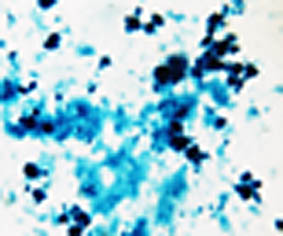
Note the contrast between the thin areas and the almost black lumps.
Prussian blue is fast to light and unaffected by weak mineral acids, but is soluble in 10% oxalic acid, browned by heat, and discoloured by alkalis. Considerable quantities of prussian blue were used to make blue printing ink, however, its sensitivity to alkali was such that it could not be used for notices near the soap making factories of Port Sunlight in the Wirral. It has a very high tinting strength – 1 part of prussian blue will make nearly 650 parts of lead white perceptibly blue – it has low opacity in oil. When prussian blue is ground in linseed oil, and allowed to stand in the tin, the mixture soon gelatinises (the authors have met this), and for this reason, despite the fact that prussian blue is a poor dryer in oil, it was apparently the custom in the paint trade to grind it in olive or whale oil. The use of the non-drying oil seldom mattered as the pigment was mainly used in small quantities to tint other paints. There are a number of prussian blues, which differ only slightly chemically. Some form a softer powder than others. All are affected by alkali, and most of them are decolourised quite rapidly when used in mixtures with zinc white (Curtis, p.36).
Smalt
Azure, Dumont’s blue, powder blue, Royal blue, Zaffre, Dutch ultramarine, bice
A potassium silicate glass
The refractive index of smalt is usually between 1.5 and 1.46
Under the polarising microscope smalt appears as white, grey or blue sharp-edged glassy particles which have a conchoidal fracture. It is isotropic. Strongly coloured blue and grey particles appear pinkish or brownish red under the Chelsea filter. Particles of weakly coloured, or completely discoloured, smalt may look like colourless glass. With some achromatic objectives discoloured smalt may appear pale violet or lilac. Apochromatic or fluorite objectives may help as ground glass will appear colourless while any blue or violet coloured particles are likely to be smalt. In practice it appears to be unusual for all the particles of smalt to be equally discoloured, and some blue particles are likely to be present. One can only establish that completely discoloured glassy particles are smalt by showing that cobalt is present. X-ray diffraction does not help as neither smalt or glass have a crystalline structure. Particle sizes are likely to lie between 10 and 50 micrometres, but can be much larger. A layer of smalt can often be recognised in a cross section because it looks rather like cracked ice. Descriptions of genuine ultramarine and smalt can make them appear to be similar, as both are likely to include many colourless and coloured particles, which show conchoidal fractures, both appear red with the Chelsea filter and both are isotropic. However, the bluest particles in ultramarine are likely to be a much stronger colour than any that will be found in smalt, and small particles of ultramarine can be more strongly coloured than the same sized particles of smalt. The red colour which is seen with the Chelsea filter is also much stronger in ultramarine than in smalt, and particles of smalt are likely to show thinner edges and more marked conchoidal fractures than will be found in ultramarine.
Smalt was made by first roasting the cobalt mineral to form cobalt oxide and then using this to colour glass. Finally the glass was ground and levigated to form the pigment.
Alkalis cause smalt to lose much of its colour. The potassium glass from which it is made often contains excess alkali and this can be leached out and affect the pigment if it is allowed to stand in water. This probably explains why damp can cause smalt paint to turn from blue to smoky grey.
Although cobalt may have been used somewhat earlier, the documentary evidence puts the first known use of smalt as a pigment to the middle of the sixteenth century in Bohemia, however, it has been recorded from Chinese central Asian wall paintings of the eleventh century A.D. [Studies in Conservation vol 28 p. 15]. The minerals from which the cobalt was obtained in Bohemia, were cobalt arsenates, and these caused illness in the men who mined them. The called the material ‘cobalt’ after the ‘kobolds’ or spirits which they believed haunted the mines. Better quality smalt was later made in Holland.
A patent was granted in England in 1605 for the manufacture of smalt, despite the fact that a Dutchman had already started to make it in England in 1604 [Harley]. Smalt was little used during the nineteenth century. However, smalt was the colour adopted for the RAF blue, and Reckitts were still making it for them until 1952.
Smalt does not cover well when painted in oil, and because it is composed of coarse, sharp-edged particles, it is difficult to work with a brush, particularly in aqueous mediums, and this probably explains the unconventional ways in which it was often used. John smith in his Art of Painting in Oil describes one alternative method of applying smalt called strewing. In this technique the powder was shattered onto a layer of wet white lead oil paint; when the paint had dried any loose smalt was brushed off. The effect was rather like ‘blue sandpaper’, and strewing was frequently used on such items as sundials, the dials of turret clocks and inn signs. Smalt interior decoration seems often to have been strewn, but it was sometimes applied with a brush in an oil or varnish medium. Where strewn smalt has subsequently been varnished, it can be difficult to determine how it was applied. It was frequently used, over blue verditer, on the cases of blue lacquer clocks, many of which have since been painted black. It was used regularly in the 17th and 18th centuries for the borders on painted soundboards of continental harpsichords. On some of these it seems to have been applied, not with a brush, but with a slip trailer so that the paint is raised and forms dots and sinuous lines. A similar effect has been noticed on some painted continental furniture. Until the end of the 19th century, very finely ground smalt was used as a washing blue to make linen appear whiter by counteracting any slight yellowing in the fabric. Washing blue was in use during the 17th century, but it is not clear whether smalt was one of the pigments that was used. Smalt was an expensive pigment and it is therefore not surprising that it was being replaced as a washing blue with artificial ultramarine about 1900 [Hurst].
In 1676 “the finest ground smalt that ever came into England” was valued at 8s, a pound. [Walpole’s Anecdotes, vol, iii. p. 137]. In 1889 Winsor and Newton charged 5/- (five shillings) for a whole pan of smalt – the same price as ultramarine ash.
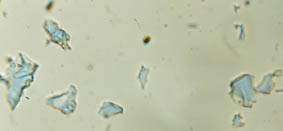
Note the conchoidal fractures, and sharp edges
colour should be more violet.
Neutral verdigris
Distilled, crystallized, or purified verdigris
Cu(CH3COO)2·H2O
Distilled, also called neutral verdigris, appears as blue or greenish blue particles of up to 20 micrometres. Some particles may appear splintery and broken, but others are likely to show cleavage planes. The material has a refractive index that is less than 1.66 and is strongly birefringent and pleochroic, changing from blue to pale green or pale blue as the stage is rotated. Extinction, which may appear to be parallel or oblique, is usually undulose, the dispersion being such that the particles may pass through a succession of colours and not become fully dark at any point. It does not turn red with the Chelsea filter. It is this variety of verdigris that is usually described in microscope literature under verdigris.
Particles of distilled verdigris are likely to be found in association with common verdigris and copper resinate. Distilled verdigris was far more expensive than common verdigris. It is also water soluble. It has only been found on its own in paint in a very few instances, but it seems to have been frequently used to form copper resinate.
Vivianite
Refractive index 1.579 to 1.636
Fe3P2O8 . 8H2O
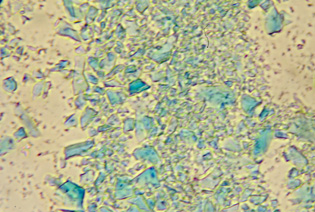
Under the polarising microscope a sample supplied by Dr. Kremer was seen to be composed of particles up to 60 micrometres long. Vivianite shows good cleavage and most of the particles were flat plates sometimes showing parallel cracks. In meltmount these flakes were nearly colourless with markedly yellow edges. Most of the particles had Becke lines that moved out but in a few instances they moved inwards (this is probably related to the form of the edges of the particles). Extinction was definite and very sharp for the cleavage flakes. The birefringence was low – few particles exhibited anything but a first order grey or white. Some plates showed slight pleochroism changing from white or yellowish to faint blue. Another, less common type of particle tended to be noticeably longer than it was wide, and had striations running down its length. Such particles showed marked pleochroism from a deep blue to white or yellow. Extinction of the striated particles was mostly undulose or oblique with anomalous colours: pinks and bronze colours appearing at the position where extinction was expected, but some particles extinguished straight. The blue particles did not show pink or red with the Chelsea filter.
Vivianite is formed by the action of phosphorous-containing solutions on iron compounds and is found in, among other places, the forests in Bavaria. according to Winchell, the mineral is colourless when fresh, but changes to blue and finally brown on oxidising. The change to blue is instantaneous when the mineral is ground, as a result of oxidation.1 The colour of the dry pigment is a dull slaty blue. It has been found in organic phosphate-rich environments, often associated with bones, decaying wood and other organic remains.
The pigment is not very strongly coloured and, depending on the medium and the varnish, can appear a greyish black. It is mainly thought of as occurring on German objects and wall paintings that can be dated between 1150 and 1235, but it has also been found on 12th and 13th century paintings at Winchester and has been tentatively identified from Anglo Saxon stone sculpture at York. The authors have been told that it was found on 18th century Bavarian window shutters. Originally, it may have come into use because there were few blue pigments available to artists at the time. Egyptian blue was probably no longer being made, and ultramarine was only just beginning to be used. Nevertheless, vivianite does not appear to have been regarded merely as a cheap substitute for ultramarine, because the two pigments were found side by side on the lectern that is preserved at the City Church of Freuenstädter and which dates from c. 1150.
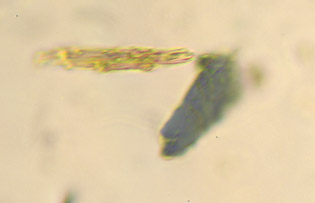
the stage has been rotated 90°


the stage has been rotated 90° compared with image above
Note the parallel cracks in the large cleavage fragment on the right
and that it has hardly changed in colour
Mactaggart, P. & Mactaggart, A. (June 2007) ‘Blue Pigments’ In: Pigment ID using Polarised Light Microscopy from: https://academicprojects.co.uk/blue-pigments/
