

Please see below details for Cobalt Green, Copper resinate, Dioptase, Distilled verdigris, Emerald green, Green verditer, Malachite, Opaque green oxide of chromium, Terre verte and Viridian.
Cobalt green
Rinmann’s green, zinc green.
A solid solution of cobalt and zinc oxides (the colour is barely affected by the amount of cobalt present). CoO · nZnO
Refractive indexes 1.94 and 2.00
The pigment appears as roughly spherical particles often showing indistinct faces. The colour can vary from colourless to a deep bluish green, depending on size. The extinction of individual particles is distinct, the smaller particles show a low birefringence, but strongly coloured particles may remain green. Individual crystals can range in size from c. 2 to 12 micrometres, but aggregates can be as large as 100 micrometres. With the Chelsea filter most coloured particles appear red, but the colour is related to the depth of the green.
The pigment can be prepared by adding a paste of zinc oxide to a solution of a cobalt salt, and calcining the product. Cobalt green was discovered by Rinmann in 1780, but it was not until zinc oxide became readily available in the middle of the nineteenth century that its manufacture became a commercial ossibility. Laurie says that the first literary reference to it as a pigment is in 1835. Roberson’s were offering it at 3/- (three shillings) for a whole cake in 1851. It is available today, but still an expensive pigment.
Cobalt green has low staining properties and no great hiding power in oil, but it can be useful in glazes. It is stable in normal conditions and can be used in mixtures. It is unaffected by alkalis, but is soluble in concentrated acids.
Copper resinate
Refractive index less than 1.66
The pigment is prepared by dissolving verdgris in a pinus resin such as Venice turpentine, colophony, or a mixture of the two. In some methods of preparation, the verdigris/resin mix is allowed to set and then ground. The resulting particles are mixed with oil and painted out. In another method the thick green resin is applied directly. [Renalte Woudhuysen-Keller and Paul Woudhuysen; Thoughts on the Use of the Green Glaze called Copper resinate and its Colour-changes; Looking Through Paintings. Editor Erma Hermens: Leiden 1998.]
When making up slides, samples need to be dispersed with alcohol or another mild solvent that will not dissolve the resin. In meltmount, samples of paint, which were probably prepared by the first method, appear as broken particles but they may contain tiny anisotropic inclusions. The refractive index is less than 1.66. The particles may appear colourless, pale yellow green, or brownish. If insufficient resin was used to dissolve the verdigris, particles of distilled verdigris may be found either as independent particles or as inclusions in the resin. The author has no information on the examination of the second type of copper resinate.
Dioptase
CuSiO2(OH)2
Hexagonal; refractive index no 1.644-1.658 — ne 1.697-1.709
Hardness 5 SG 3.28
In plane polarised light dioptase appears as pale bluish green thin particles which have perfect cleavage and consequently the particles are likely to show flat tops. The particles are very slightly pleochroic from a stronger to weaker colour. In addition most of the particles show low relief and all the particles twinkle when the stage is rotated. They do not show a red when illuminated through the Chelsea filter.
Dioptase is a beautiful emerald green uncommon natural mineral that is found in the Ural mountains, in Kazakhstan, at Soda Lake mountains in Saint Bernadino California, in S.W. Africa at Tsumeb and in French Congo at Mindouli. Its use as a pigment has been recorded from a neolithic plaster-like statue found in central Jordan and also from Russian religious icons.
Neutral verdigris
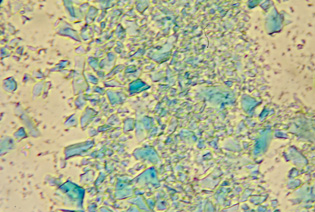
Distilled, crystallized, or purified verdigris
Cu(CH3COO)2·H2O
Distilled, also called neutral verdigris, appears as blue or greenish blue particles of up to 20 micrometres. Some particles may appear splintery and broken, but others are likely to show cleavage planes. The material has a refractive index that is less than 1.66 and is strongly birefringent and pleochroic, changing from blue to pale green or pale blue as the stage is rotated. Extinction, which may appear to be parallel or oblique, is usually undulose, the dispersion being such that the particles may pass through a succession of colours and not become fully dark at any point. It does not turn red with the Chelsea filter. It is this variety of verdigris that is usually described in microscope literature under verdigris.
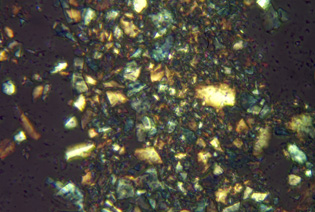
Particles of distilled verdigris are likely to be found in association with common verdigris and copper resinate. Distilled verdigris was far more expensive than common verdigris. It is also water soluble. It has only been found on its own in paint in a very few instances, but it seems to have been frequently used to form copper resinate.
Emerald green
Schweinfurt green Paris green N.B. Vert emeraude does not refer to emerald green but to viridian.
Copper aceto-arsenite Cu(C2H3O2) · 3Cu(AsO2)2 Refractive index 1.71 – 1.78
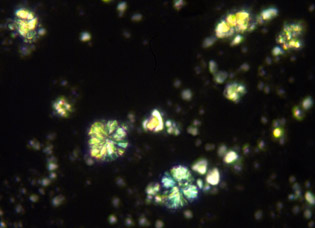
Under the microscope the pigment appears as grass green particles. Typical particles take the form of circular, lobed, flower-like polycrystals often with a dark centre. Between crossed polars, first order yellow and second order blue colours are likely to be seen occupying adjacent quadrants. The polycrystals are usually from 5 – 20 µm in diameter, and are easily broken up which may explain their apparent absence in some samples. Other crystalline forms that can occur include particles that are wedge-shaped and may show similar colours to the entire flowers. Others may be flat and semi-circular or parts of circles that are bounded by a chord or they may be formed like gothic arches which often form as twins and appear back to back. When the stage is rotated brushes may be seen to move across these particles and occasionally they take the form seen in biaxial interference figures. Pleochroism may be observed in some weakly coloured particles – pale green to white. The pigment does not appear red under the Chelsea filter. If the characteristic flower-like particles are present the pigment is easy to identify. In some samples, few of these particles occur, and it has been suggested that with some methods of production they may be completely absent. Emerald green is sometimes thought to bear a resemblance to spherical malachite, but between crossed polars small particles of spherical malachite show a stationary cross.
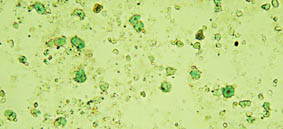
There are several methods of manufacture. The size of the particles and the depth of colour of the pigment can be regulated by the strength of the solutions, and the best results are obtained from weak solutions and slow crystallization. In some methods the pigment may take a week in the summer and as much as a month in the winter to form. Quicker methods are sometimes used; in one the pigment is precipitated from a hot solution of verdigris, white arsenic, and sodium carbonate.
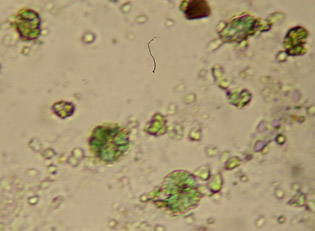
Emerald green was first prepared in 1814 in Schweinfurt – hence the name Schweinfurt green, which is often used for it. It was sold by artist’s colourmen until some time after the last war. In the 19th century it was used not only as an artists pigment, but also for printing wallpaper, and as an insecticide. The pigment has good colour but is not strongly staining and much of the colour is lost if the particle size is reduced. This meant that considerable care had to be taken when making it up into paint, and Cruickshank Smith says that it could turn almost white if the rollers of the roll mill were set too close, or the pigment had to be run through a second time.
As a pigment it was relatively cheap. Winsor and Newton’s catalogue of 1889 lists it at nine pence an ounce, the same price as lamp black. It is reasonably stable in oil, but is blackened by sulphurous air and also if it is used in mixtures that included sulphide pigments. It is readily decomposed by acids, warm alkalis, and heat. The pigment is highly poisonous and can be decomposed by moulds in damp situations when it gives off a toxic gas containing arsenic. The pigment was readily available until the 1960s; samples from that period still contained the characteristic polycrystals. The pigment is not available commercially today in the USA or Europe.
See also Emerald Green and Scheele’s Green by Inge Fiedler and Michel A. Bayard in Artists’ Pigments a Handbook of their History and Characteristics Vol 3.
Green verditer
This is distinct from ‘spherical malachite’ and was probably produced when blue verditer was made at slightly too high a temperature. Under the microscope samples seen by the authors appear rather like a small–sized blue verditer. Like blue verditer the particles are rounded and often have a dark spot in the centre, but green verditer has a tendency to be lobed or misshapen and if viewed between crossed polars with the red plate, it lacks the small rods that can be seen in most samples of blue verditer, and tends to be composed of one or two irregularly shaped crystals. The colour of the particles may appear greener than those of blue verditer, but this may not be obvious. It was probably used quite widely in the seventeenth century, and has been found, among other places, on painted hangings. In view of the name ‘blue verditer’, ‘green verditer’ may have been known originally as ‘verditer’ and was probably made earlier than the blue variety.
Mineral malachite
Mountain green, green bice.
Naturally occurring basic copper carbonate CuCO3 ·Cu(OH)2
Monoclinic; refractive indexes 1.66 to 1.91
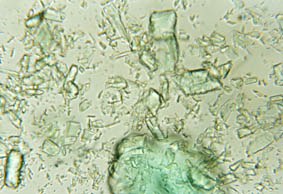
As malachite pigment is made by grinding the mineral, almost any size of particle can occur and a wide range of particle sizes is often seen in preparations. Particles tend to be of two basic forms, those formed from a single crystal, and those which are a bundle of elongated crystals. Particles formed from a single crystal are likely to show flat tops and have geometrical outlines formed of sharp internal and external angles due to good cleavage of the mineral. When mounted in Meltmount n = 1.66 some particles may twinkle, and others may show pleochroism when the stage is rotated. Small particles tend to be colourless or only very faintly coloured. Between crossed polars the birefringence is high enough for first order red or second order blue to appear on quite small particles; fourth order colours are not unusual in larger particles. Fibrous particles do not extinguish: for single-crystal particles, extinction may be oblique or parallel and varies from distinct to undulose in which case a dark bar may appear to pass over a particle when the stage is rotated. Malachite does not appear red with the Chelsea filter.
Mineral malachite is an important ore of copper and it is found in a number of parts of the world. The pigment is prepared by grinding and washing. The dust from grinding the pigment is poisonous if inhaled.
The pigment was used for eye make-up in Egyptian times. It has little staining power, covers badly in oil and not very well in watercolour, although the colour it gives is a very bright green. The angular shape of the particles of ground natural malachite probably explain its bad handling, and its gritty quality did not make it popular with watercolour painters and may explain the choice of the synthetic spherical malachite in fifteenth-century Italy. Mineral malachite occurs fairly frequently in medieval paintings, but it seems to have been seldom used during the 17th and 18th centuries, though examples of its use in the West as late as 1800 are recorded and there are references in the Catalogue of the 1851 Exhibition that seem to imply that it was still being used at that date. However, the authors do not know of the pigment being recorded from any nineteenth-century object, nor have they seen a reference to it in artist colourmen’s catalogues. The writers have found it on seventeenth-century harpsichord soundboards. In the East it was used at least until the 1939-45 war and probably since, though the authors’ attempts c. 1980 to get samples from Japan failed. The pigment can be obtained today from Kremer.
Spherical malachite
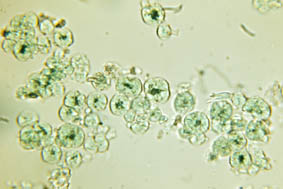
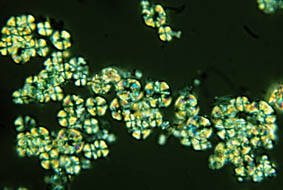
In the spherical form of the pigment, which is man made; the particles are made up of radiating crystals. Under the microscope the form can be seen to consist of near spherical particles from c. 3 to 80 micrometres or larger in diameter. The particles often have a black spot in the middle and may have spherical excrescences. Between crossed polars small particles of spherical malachite show a black cross that remains stationary when the stage is rotated. Larger particles show brightly coloured rings. If a first order red plate is used, it will be seen that the radial direction is fast. Because of the distinct form and relatively large size of some of the particles, it is possible to recognise this pigment in cross section if it is viewed at a sufficient magnification.
Spherical malachite can be made by mixing solutions of potassium or sodium bicarbonate and copper nitrate or sulphate. A fine precipitate forms which changes on standing for some time to the rather coarse spherical particles.
The spherical form of malachite was known to Cennini, who knew that it was not of natural origin. However, it only began to be recognised as distinct from ground mineral malachite in the 1970s by the conservation and fine art world, but for some time it was unclear whether it was an unusual natural form, or a man made product [National Gallery Technical Bulletin vol 1, p. 13; also vol 2, p. 23].
It has now been recorded from a number of fifteenth century Italian paintings, from a thirteenth century Chinese polychrome sculpture in the Victoria & Albert Museum (though it was not described as such in the publication relating to the object Guanyin: A Masterpiece Revealed by John Larkin and Rose Kerr, London 1985), and from a sixteenth century Russian fresco [Studies in Conservation Vol 35 No 2 May 1990 pp.81-8].
Opaque green oxide of chromium
In Germany it was called chromoxyd grün – stumpf but the name has been changed to chromoxydgrün. Anhydrous oxide of chromium. Cr2O4
Trigonal according to Winchell: hexagonal according to Gettens and Stout. n = c. 2.5
The particles are mostly smaller than 1 µm, and in Meltmount show high relief. If looked at carefully it will be seen that these small particles are often warm (reddish or brownish) in colour, though aggregates appear a dull green. This colour can be seen with either apochromatic or achromatic objectives and is a very useful feature, but the small particles do not appear red with the Chelsea filter. In addition to the small particles one is likely to find bigger brighter green particles that can be as large as 15 micrometres, some of these, particularly if they are strongly coloured, may appear red or brownish with the Chelsea filter. Between crossed polars most of the particles appear green, but a few may appear a brownish colour.
The pigment is usually made by calcining a mixture of potassium bichromate with boric acid or sulphur.
From a paper of 1809 by Vauquelin, who discovered chromium, it is clear that the pigment was already being used by the Sèvres porcelain factory at that date. It was listed by Winsor and Newton in the 1840s and was being sold by Field in 1815. A sample appeared in the first edition of his Chromatography. The pigment is extremely stable: it is not affected by light, heat, strong acids or alkalis. It is strongly staining and has considerable covering power.
Terre verte
Green earth A hydrosilicate of Fe, Mg, Al, K, but other minerals are likely to be present
Monoclinic. Mineralogically, celadonite or glauconite
The refractive index varies but is c. 1.62-1.65 and all indexes are less than 1.66
Under the microscope particles of terre verte are very variable in colour and the particles may be colourless or grey, yellow-green, blue-green or even blue. Particles of yellow hydrated iron oxide are also likely to be present. The particles normally have a micaceous or plate-like structure, but this is unlikely to be visible. In most preparations the plates are likely to lie parallel with the microscope stage and in Meltmount such particles will exhibit a low relief, and a characteristic undulose or ‘speckled’ extinction, with wandering rather spotty or mottled areas. However, occasional particles that are unusually well optically oriented may exhibit a sharp extinction. The larger particles – they may be up to 60 micrometres – are likely to be rounded and have a rough surface. Particles that lie with their plates perpendicular to the stage may appear to be fibrous, and may show parallel extinction and a higher relief than the rounded particles. These fibrous particles may be more strongly coloured than the rounded particles and exhibit pleochroism. The plates are likely to be length slow if tested with a red plate. Some particles, principally the blue-green ones, may appear reddish if illuminated with a Chelsea filter. As with most mined pigments, quartz is frequently present in samples of the pigment, often in large quantities. Mineralogically terre verte can be either celadonite or glauconite but there does not appear to be a way of distinguishing the two varieties with the microscope.
Terre Verte is dug, or mined and prepared by levigation. In the past small pockets of fine coloured pigment were often exploited locally, but most modern artists’ colourmen require large quantities of a constant product to make it worth marketing. It was found in a number of places including Germany, France, Cyprus, Italy and Cornwall. The authors have found a small pocket on the Blackdown hills in Somerset.
Terre verte may be found in paint from all periods. It has been found in early Indian painting, and has been used in Europe since classical times. According to Kühn there was a marked increase in its use at the beginning of the eighteenth century. Terre verte of very fine colour was available in the past, often from very small deposits. That which is available today commercially is poor by comparison and is often improved by the addition of transparent or opaque green oxide of chromium or green dyestuffs. The best pigment available during the recent past came from Cyprus but little, if any, has been exported since the Turkish invasion. Terre verte has become available from Bavaria and Russia, but though samples of the former variety from Kremer have not been improved they do include a great deal of quartz. Poor quality terre verte, which can be grey rather than green, has sometimes been used as a base for dark coloured lake pigments. Terre verte is a stable pigment, but browns on heating and is affected by dilute alkalis and acids. ‘Burnt’ terre verte was prepared by heating poor coloured raw terre verte, to make a transparent brown pigment which contains a high proportion of yellow particles. A few rounded particles may behave in a similar manner to the green when viewed between crossed polars. Burnt terre verte mixed with brown umber and asphaltum is mentioned as being suitable for painting “The shadows of the flesh” in the Paduan MS which is dated by Mrs Merrifield to the second half of the seventeenth century. [Medieval and Renaissance Treatises on the Arts of Painting Dover reprint 1967/1999 ccxxi]. Burnt terre verte is now available from Kremer.
Viridian
Vert emeraude, Guignet’s green, transparent oxide of chromium. In Germany it used to be called chromoxyd-grün – feurig, but is now called chromoxydhydrat grün.
Hydrated chromium oxide Cr2O3 . 2H2O Refractive index is rather variable but c.1.82 to c. 2.12
Under the microscope the pigment appears as translucent, blue-green, rounded grains with a rough surface. Occasionally particles showing traces of a crystal form are present. Typical particles are 4-8 micrometres, but one of 20 micrometres is not exceptional. The particles have good relief and an undulose extinction. Most particles appear a warm grey with the Chelsea filter, but a few may appear to be distinctly red. If viewed with the red plate, most of the particles will be seen to be composed of more than one crystal that have grown together and which lie in different directions – this is a useful feature in recognising the pigment. The crystals are mostly length slow. Very small yellow-green crystals, which in some samples are large enough to be seen to be doubly terminated, have been present in all the samples of viridian that the authors have seen.
The pigment is prepared by bringing an alkali chromate with excess boric acid to dull red heat and then raking the product into cold water and allowing it to stand to hydrate. Finally it is ground wet.
According to Church, viridian was first made in Paris in 1838 by Pannetier, a colour maker. Binet took over the process when Pannetier died, and the secret of how it was produced was kept until Guinet patented the method in 1859. Harley says that Winsor and Newton offered it as an oil colour as early as 1849. It is listed in their 1868 price list as a moist watercolour and priced at 3/- (three shillings) for a whole pan. The dry colour was listed in 1889 at 3/- (three shillings) per ounce.
The pigment can be converted to the anhydrous form by strong heat. It is unaffected by light, weak acids and alkalis. It is transparent in both oil and watercolour and has medium tinting strength.
Mactaggart, P. & Mactaggart, A. (June 2007) ‘Green Pigments’ In: Pigment ID using Polarised Light Microscopy from: https://academicprojects.co.uk/green-pigments/
