

The next course will start on 14th January 2027.
Please message us to receive the enrolment form. Due to high demand early enrolment is recommended.
The course provides an introduction to chemistry for people with little (for instance lower school chemistry studied years ago) or no chemistry, providing an excellent background to the theory which is taught at many conservation training courses in Universities. Indeed several conservation training establishments recommend this course to potential students who may have an insufficient level of chemical knowledge. Taking this course should enable students to gain greater insight into their everyday conservation work. Please see syllabus below.
Location: This is an at-home course. The coursework, carried out independently, consists of reading, online quizzes, at-home experiments and assignments. Internet access is required. Feedback is given by markers periodically after the work has been submitted.
Cost: UK students: £970; Europe students: £1020; Rest of the World: £1070
The course costs covers most material costs, shipment (without custom duties), Moodle access, feedback and marking, as well as a certificate when the course is finished successfully.
Enrolment: There is a limited number of 35 places available. Early enrolment is highly recommended. We aim to conclude the enrolment process in good time before the start of the course to ensure you receive the course materials on time. If you have any special educational needs or disabilities please let us know in advance.
To enrol for this course, please make an enquiry here. You will then receive an enrolment form from our office.
This at-home course is conducted in English three times a year.
Syllabus
This course is all about chemistry and is not about conservation treatment procedures. It aims to give you the chemical background to better understand the chemical processes behind the processes described in the conservation literature or taught at conservation training establishments. It is therefore not aimed at any particular branch of art/object conservation but rather just at the chemistry that is common to all.
The syllabus is aimed at major conservation issues: e.g. types of materials, the environment, cleaning, and deterioration. If chemical principles are to be applied in practice, it is important to understand the implications of the chemical action.
The course is divided into four parts. An “Introduction” to chemical explanations of the physical world i.e. materials of common experience, air and water. “First principles” carries this further and explains the language of chemistry. “Chemistry in action” samples the chemistry of materials that are of use in conservation. The final block, “Chemistry and the conservator”, applies the knowledge gained in the previous blocks to the world of conservation.
Part 1 – Introduction: to chemical explanations of the physical world draws examples from the materials of common experience, air and water.
Unit 1: Preliminaries
Unit 2: Air and Water
Part 2 – First Principles: lays the foundations and explains the new language of chemistry.
Unit 3: Particles
Unit 4: Reactions
Unit 5: Chemical Compounds and Molecular Models
Unit 6: Health and Safety
Part 3 – Chemistry in Action: samples the chemistry of materials that are encountered in conservation.
Unit 7: Solutions
Unit 8: Electrochemistry
Unit 9: Organic chemistry
Unit 10: Polymers
Part 4 – Chemistry and the Conservator: applies the knowledge gained in the previous blocks to conservation.
Unit 11: Effects of Water
Unit 12: Cleaning
Unit 13: Adhesives
Unit 14: Degradation
Each block of work corresponds to one month of the course with a deadline at the end of each month. The course requires around 15 hours per week of work, all work is carried out independently. The student works through the course folder and is prompted at various points to answer questions or do experiments, there are no lectures. You will need to achieve a final mark of 40% or over to receive a certificate.
Course Authors:
C.V. Horie (Collection Care & Conservation Consultant) and Dr. D. Kenyon (Adult Education Lecturer)
Course Materials
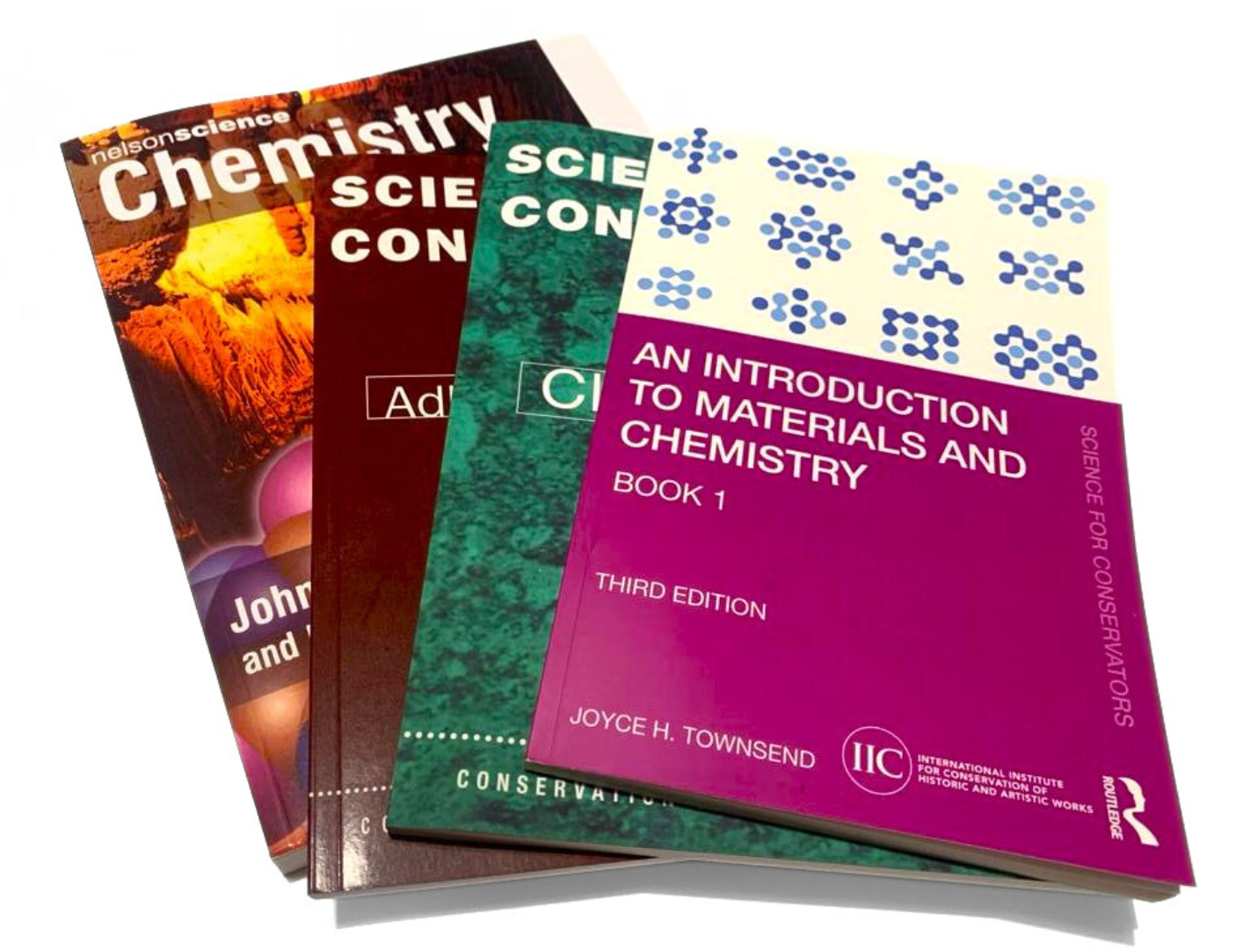
You will be supplied with a course pack which contains:
- a chemistry text book
- 3 Science for Conservators volumes
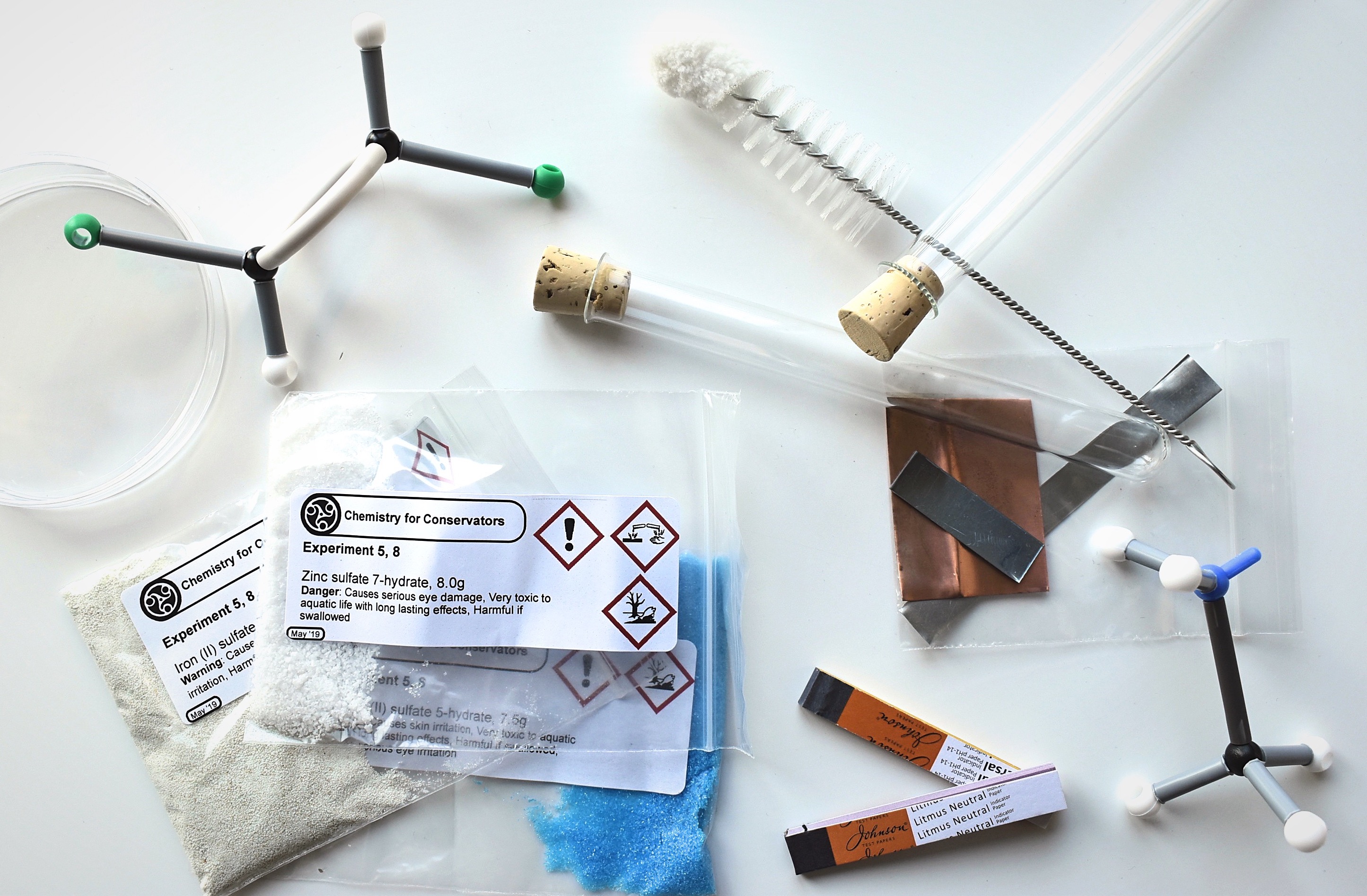
- Experiment pack containing basic equipment and chemicals
- Course folder
Why Conservators Need Chemistry
Chemical processes underlie many of the practices and techniques used in conservation. From environmental control to restoration, chemical interactions take place between the object and the outside world. They may be harmful or benign. If you are to apply chemical principles in practice, you must understand the implications of the chemical interaction.
 Chemistry is the study of substances which make up the objects to be conserved. Chemistry is one component of the material science of objects, which can include physics, mechanics and biology. Chemical properties frequently determine treatment methods and materials.
Reasons students are taking this course
‘… Chemistry for Conservators both to help me with enrolment for a study program and studies at university, as well as to improving my knowledge while handling collections’ items at my current job.’ – 2021 student
‘I am interested in taking the Chemistry for Conservators course to gain a more comprehensive knowledge of what I practice everyday. A deeper understanding of chemistry will give me the vocabulary to better explain chemical processes to clients. Staying up to date with current best practices is essential to being an effective conservator. A better understanding of chemistry will make interpreting the contemporary literature on conservation treatment more informative and rewarding. This course will help me to make more informed treatment decisions to best serve my clients.’ – 2021 student
‘This IAP course has been recommended by the university as an alternative to IGCSE Chemistry, which is and entry requirement…’ – 2021 student
Impressions from past students
, …many thanks for offering this great course.! Overall, it was a challenging but wonderful learning experience. I found its organization, navigation of the module and the complete structure working very well.’ – 2022 student
‘I absolutely loved every bit of it! I learned so much.’ – 2021 student
‘I am really enjoying the course! It’s very well put together, very interesting, and the box of materials that you sent me is so clearly-labelled and well-packaged.’ – 2021 student
‘I thought I would never be able to study conservation as my science education ended with GCSE science. (…) In summary, this course will be a valuable asset in obtaining my career aspirations.’ – 2020 student
‘All in all fantastic course’ – 2020 student
‘The University has recommended this course as a way to fulfil the Chemistry entry requirement since I have not taken a Chemistry course since High School.’ – 2020 student
‘This was an excellent course. I thoroughly enjoyed the content and how the course material was presented. I am so glad I took this course because I learned so much from it. Thank you IAP and to the course instructors for offering this course!’ – 2017 student
‘Thank you for giving me the opportunity to study this course – I found it thoroughly interesting and know that it will be beneficial to my future studies.’ – 2009 student
‘It has opened my eyes not only to new aspects of Chemistry but most importantly, just how integral it is to Conservation and the necessity of grasping it.’ – 2007 student
‘I would highly recommend the course to anyone wishing to do conservation’ – 2005 student
