

Please see below details for Sienna, Umber, Cadmium red, Chrome red, Cobalt arsenate, Cobalt phosphate, Iron red, Red lakes and Madder, Quinacridone violet, Red lead and Vermilion.
Raw and Burnt Sienna
Refractive index: Raw 1.87 -2.17. Burnt c. 1.85
Under the microscope these pigments look like a yellow ochre with very large particles. Rounded rough-surfaced particles of 10 micrometres are likely to be common, ones of 60 micrometres are not unusual, and even larger particles may be encountered. Birefringence is variable, a sample can include some particles that are practically isotropic, while others are not. The anisotropic character may even be confined to parts of particles. In raw sienna most of the particles will be yellowish, but reddish particles are usually also found. In burnt sienna the particles appear similar, but are light to deep red in colour. The rods which tend to be a characteristic of yellow ochre have not been seen in samples of either raw or burnt sienna that the authors have examined. Nevertheless, when examining samples from painted work microscopically, it may not be practical to distinguish raw sienna from other iron earths if the particles are on the small side. Even if one is sure that a sample contains raw Sienna, it may not be possible to say that yellow ochre has not been mixed with it. The characteristic colour of burnt sienna usually makes it identifiable.
The pigment is selected from mined material, ground and then levigated and dried. The burnt form is prepared by heating the natural material.
Raw sienna is so called because some of the best grades were found near the city of that name. It is also found in, among other places, the Hartz Mountains, Germany and America. The pigment tends to form in pockets where water, which has passed over manganese and iron bearing strata, has accumulaated. The deposits do not appear to be of great age in geological terms as ‘bronze idols and other articles of human anufacture have been found in them’ [Hurst].
Raw sienna is slightly warmer in colour than yellow ochre and, as one would expect from the larger particle size, noticeably more transparent. The burnt form is a reddish brown.In Europe, siennas have been used ontinuously in painting and may be found in all mediums. To the artist the value of the siennas lie in their transparency and they were consequently use as a glazing pigment. They were used extensively by grainers for imitating wood.
The pigment is permanent to light, though those siennas which include some organic matter may lighten slightly. Its reaction to acids and alkalis is similar to yellow ochre.
Umber
Refractive index: Raw umber 1.87-2.17. Burnt umber 2.2-2.3
Under the microscope it can be seen that raw umber is composed mainly of rounded particles ranging in colour from a dull greenish yellow to black, with some warmer orange particles and a few that are reddish. The particles vary in size from 1 to 10 micrometres. Between crossed polars, the birefringence of the pigment is low, but samples may include quartz and other birefringent particles. Burnt umber appears similar as far as particle size and shape are concerned, but although some small greenish-yellow particles are likely to be present, most are red or orange so that the impression is of predominantly warm coloured particles. McCrone says that burnt umber is isotropic; however a number of the particles in examples examined by me did not remain entirely dark when rotated between crossed polars.
Cadmium red and cadmium red lithopone
Refractive index 2.5 to 2.77 usually isotropic
In Meltmount cadmium red can be seen to be composed of very even-sized – less than 1 micrometre – rounded particles of intense red colour. Although the particles of the pigment appear to be a fiery red colour between crossed polars, the particles may be amorphous, or belong to the cubic, or hexagonal systems, and these tiny particles may be an aggregate of more than one crystal form. Because of the high refractive index, the rounded form of the particles and their tendency to form rounded aggregates, edge depolarisation occurs in isotropic particles and the colour of the particle is visible. When a dispersion is viewed between crossed polars it is often possible to see dark crosses with their arms parallel to the polariser and analyser in the individual rounded isotropic particles. This usually needs a magnifications of x 1000 or greater. If these crosses are viewed with a red plate adjacent quarters do not appear different colours. Once these crosses have been observed, they can usually still be detected at slightly lower magnifications as grey flecks in the upper and lower quarters of rounded particles. The very small sized particles of other red pigments tend to appear black or colourless in plane polarised light. With cadmium red, the smallest particles are clearly red.
The variety of cadmium red most commonly encountered today is cadmium red lithopone, which can be made as a precipitate by mixing barium sulphide solution, in which selenium has been dissolved, with cadmium sulphate. The precipitate is dried and calcined. Its appearance under the microscope is similar to the pure variety. Writing about the lithopone variety, Gettens and Stout say that ‘at high magnifications irregular prismatic grains of barium sulphate can be seen’. So far the authors have failed to observe them. In the Particle Atlas, Vol III a SEM photograph of the pigment shows no such crystals although the EDXRA spectrum shows that barium is present, and Kremer has told the authors that barium sulphate is isomorphous with cadmium sulpho-selenide and forms a mixed crystal with it.
Cadmium sulpho-selenide is prepared by precipitating cadmium sulphate with sodium sulphide and selenium. By adjusting the proportions of selenium and the conditions, shades ranging from vermilion to maroon may be obtained.
A cadmium red was patented in 1892, but the pigment did not become a commercial possibility until about 1910. The lithopone variety first appeared in 1926 – it is almost as opaque as the normal cadmium red and is considerably cheaper: it cannot be distinguished from cadmium red with the microscope. Cadmium red is stable under all normal conditions and is light fast. It is strongly staining and opaque in both oil and watercolour.
Chrome red
Persian red, Derby red, American vermilion, Chinese red, Victoria red, Chrome scarlet.
Basic lead chromate. Pb3Cr2O9 ? Probably orthorhombic
Refractive index 2.42 – 2.62 [Winchell]
Under the microscope the pigment appears as rectangular tabular crystals that are highly birefringent and strongly pleochroic – orange to yellow, but some small yellow particles may not change colour. Extinction is parallel and sharp, but small yellow reds that show oblique extinction may be found.
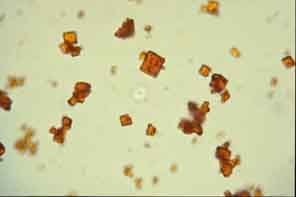
The pigment can be prepared by boiling a strong solution of potassium dichromate with white lead and a small amount of caustic soda. It was also made from litharge.
Chrome red was first mentioned by Vauquelin in 1809 and it probably came into limited use as an artist’s colour during the early part of the nineteenth century. It occurs in Winsor & Newton’s catalogues from 1840-42 as chrome scarlet, but does not appear in later editions. [Harley] N.B. It does appear in the 1889 edition as chrome red. It was still being used by some artists at the turn of the century. Commercial decorators continued to use it well into the twentieth century, and it was still being discussed in a book by Remington and Francis as late as 1957. The authors have identified one sample and have seen another that came from nineteenth-century interior decorations. It has been identified from at least one French impressionist painting. There was a suggestion that it might make a good rust-inhibiting priming coat on iron and steel.
In normal conditions the pigment is stable but like all lead pigments it is affected by sulphur dioxide. If it is ground too much the colour changes to orange. [Hurst]
The term Chinese red seems to have been applied to a colour, rather than a pigment that was less scarlet in tone than Persian red, ‘Chinese red’ was sometimes used as a name for lead chromates that had been ‘topped up’ with a dye. [Smith]
Cobalt arsenate or Cobalt violet light
Refractive index c. 1.71 to c. 1.79
The particles are rather irregular in shape, those over 4 micrometres are usually noticeably coloured, but small particles are almost colourless, they may appear slightly greenish with most achromats. They show good relief. Between crossed polars the particles are strongly birefringent, large clear particles may have a sharp extinction but others are likely to have an undulose one. Most of the larger particles can be seen to be pleochroic, pink to pale pink. The particles range in size up to about 10 micrometres. A few length slow rods may be seen and groups of three radiating crystals may be found.
Crown says that the pigment was discovered in 1859, Mayer says that it was used as a pigment from about 1860. Probably occurs mainly in watercolours.
Cobalt phosphate
Anhydrous cobalt phosphate. Co3(PO4)2
The refractive index is rather variable n = c. 1.65 to c. 1.81
Under the microscope, the pigment tends to be in the form of irregularly-shaped, plate-like particles and broken crystal forms, which may include gas bubbles. The particles range in size from 4 to 50 micrometres. It is very clearly pleochroic and shows a variety of colours from red to yellow to pale lavender. Between crossed polars the extinction is dispersed and consiquently the interference colours are anomalous; it appears to show second order green and possibly third order colours. Many particles do not extinguish but merely change colour as the stage is rotated. In non-plane-polarised light, the particles vary in colour from bluish-red to violet and become strongly red with the Chelsea filter.
The method of preparing this pigment was first published in 1859. It is made by precipitating a soluble cobalt salt with disodium phosphate, washing the precipitate and then heating it strongly.
This pigment, often called cobalt violet dark, is extremely stable; it is unaffected by most reagents and sunlight. It is reddish violet in colour, is transparent in oil, has low tinting power, and exhibits pronounced purple/violet metameric effects. It can be used in all techniques. It was not listed by Winsor and Newton in 1896, but was listed in 1928.
Iron reds
The refractive index is likely to lie between 2.45 and 3.22
Under the microscope the iron red pigments present a diverse appearance. Haematite may include quite large transparent splintery particles. It can also appear as roughly circular particles with a radiating structure, or segments broken from them. In colour these can vary from light red to almost black, with circular particles generally showing less intense colour between crossed polars. Samples of natural Indian red are mainly composed of dark red particles of less than 1 micrometre, but may include relatively large transparent flakes which may or may not show traces of a hexagonal outline. These are likely to remain dark between crossed polars because they usually lie with the optic axis vertical to the stage. Such particles produce bright specks in the dry pigment, and Mrs Merrifield says that “The real Indian red has a sparkling appearance, which is wanting in the common sort. [Medieval and Renaissance Treatises on the Arts of Painting Dover reprint 1967/1999 clxxi] Micaceous haematite which was sometimes referred to as shining ore is almost entirely composed of such particles, often of large size. It was use in rust inhibiting paints, which were used particularly on large engineering works such as bridges. It is found in a number of parts of the world and particularly in Devon (England) where it was mined at the Great Rock mine near Hennock, and also at the Hawkmore, and Plumley Mines, both near Bovey Tracey and only about 3 miles from Hennock. Svedenstierna visited the area in 1802 and mentions that shining ore is mined near Moreton Hampstead, which is about 10 miles from Hennock, and that it “is sold at six guineas a ton, and a great deal of it is sent to London and other places in England, where it is used for various purposes instead of plumbago or graphite, and particularly for cleaning and polishing certain parts of cast iron such as steam cylinders, hotplates, etc, which not only thereby receive a fine appearance, but are also protected from rust.” [Svenenstierna’s tour Great Britain 1802-3 The Travel Diary of an Industrial Spy Translated by E. L. Dellow David & Charles 1973 p29] He does not specifically mention its use in paint. Ground haematite can usually be distinguished from dry process vermilion because haematite is likely to show parting parallel to the base plane and possibly parallel to the rhombohedron. The fracture tends to be conchoidal and particles are likely to have a splintery appearance with sharp edges or pointed ends. Dry process vermilion, on the other hand, tends to include particles with striations that run parallel to the length of the crystal and with ends that are roughly broken but not splintery. Most iron red pigments are very finely divided (less than 1 micrometre) and appear orange in colour. It is impossible to distinguish natural from artificial forms unless earthy material is present. Between crossed polars, all the iron reds usually appear red with little variation in the colour though with large particles the polarisation colours may include yellow and orange. Fine particle iron reds can be distinguished from cadmium red because the colour of small particles of cadmium red are a far stronger and brighter red, and between crossed polars at high magnifications, a stationary cross can be seen in many particles. Iron red pigments can be made by heating poor quality yellow ochre and these pigments retain the typical particle shapes and sizes of the ochre that has been used.
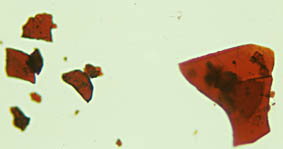
Red lakes including madder
True lakes are dyestuffs fixed onto a base with a low refractive index to produce a colour suitable for glazing. The term has, however, come to include dyestuffs precipitated onto other bases with higher refractive indexes to produce opaque colours. The natural red dyes include madder, kermes, lac, carmine, and brazil wood. Lakes seem to have sometimes been made by combining these dyes (c.f. National Gallery Technical Bulletin No 1). In the past, madder was probably the most important dyestuff used by red lake makers, but today synthetic alizarin has largely replaced natural madder. The bases used include: barytes and blanc fixe, the natural and artificial varieties of barium sulphate as well as aluminium hydroxide, and chalk. Witherite (natural barium carbonate) and its artificially prepared counterpart, which was sometimes confusingly referred to as blanc fixe, and which appears rather similar to the sulphate, are also reputed to have been used as a lake base. In the past alum, AlK(SO4).12H2O, was probably the most widely used material when making lakes. Madder was traditionally precipitated with alum and potassium carbonate so that the colour was fixed onto aluminium hydroxide, which is isotropic and has a refractive index which varies between 1.50 and 1.56.
Microscopic features
The base of a lake determines all the microscopic features apart from the colour. The relief of all the red lakes is low, and the refractive index is usually slightly below 1.66. Lakes on witherite, and its synthetic equivalent have a refractive index that is slightly greater than 1.66. Apart from lakes, all the mineral and manufactured red pigments that were used in the past have much higher relief than the lakes. Alizarin lakes on blanc fixe can appear to have quite good relief because of the strength of colour and the contrast of the colour with the background. However, if the preparation is illuminated through a red filter it will be clear that the sharp edges are due to colour contrast rather than relief. Only one red dyestuff has a distinctive optical feature: natural madder fluoresces red under long wave U.V. It also fluoresces under deep blue light, and the fluorescence can be seen by using a suitable blue filter that does not pass red light below the sub-stage condenser, and an orange or red filter in one of the microscope slots above the objective or by fitting it into an eyepiece. The orange/red filter will absorb all the blue light but pass the fluorescence. The preparation will need to be illuminated very strongly, and it still may be necessary to reduce the ambient room lighting and cup ones hands round the eyepiece to form a light proof connection to ones eye. Lakes on an alum base are isotropic and often have quite large particles which show conchoidal fractures; those on blanc fixe have very fine particles which may form irregularly shaped aggregates, they also have a very low birefringence, and the fact that the particles are anisotropic may be missed unless the microscope has a very bright light source.
Madder is prepared from the root of Rubia tinctorium which, until alizarin was synthesized in 1868, was grown extensively on the Continent. The plant was grown on a small scale in England, but the bulk of the root was always imported. Two colouring principles are involved; alizarin and purpurin. Purpurin is not a good colour, but it is the part that provides the fluorescence. The primary use of madder was for dyeing cloth, but a small amount was used by specialist madder-lake makers, who were very secretive about the techniques they used, and attempts to follow the numerous published methods have not produced a good colour. As a dye, madder seems to have been used in Roman times, and a madder-lake pigment has been identified from an Egyptian painting of the Graeco-Roman period. Thompson suggests that in the medieval period it was used less than brazil wood and only regained its importance during the seventeenth century. Rose madder was a fairly expensive colour: Winsor & Newton list water-colour cakes at three shillings [15p] in 1868, and dry pigment at six shillings an ounce in 1889. It was sometimes combined with carmine and ‘madder carmine extra’ cost one pound four shillings an ounce at the same date.
Brazil wood is a general term for a number of timbers of the genus Caesalpinia which yield a red dye. At first, the timbers used came from Sri Lanka, which till 1972 was called Ceylon. Later, timbers which yielded a greater quantity of dye were discovered in other parts of East Asia and eventually in South America. (Brazil wood was so called long before South America was discovered and the country was named after the timber not the other way round.) The wood was first rasped to reduce it to a coarse powder from which the dye could be extracted by boiling it in water. (In Holland the rasping was often the work of men in prisons.) In England the pigment was often referred to as ‘rose pink’ and it was recommended for washing maps and prints, and for staining paper hangings.
The dye used in the manufacture of ‘lac’ (Indian lake), is extracted during the process of refining crude shellac. The basic material is the product of the insect Coccus lacca. The pigment has been used in Europe since the eighteenth century, and was used in India earlier. This pigment has not been available in England since the nineteenth century. It could be prepared by treating seed lac with a solution of soda or potash, followed by an addition of alum. The product contained an alumina-resin soap. Another method, which was supposed to have been used in India, involved treating the stick lac to extract the dye and then precipitating it with lime-water [Hurst]. A packet labelled ‘Indian Lake’ is among the Cotman pigments at Luton Museum. When examined the red/pink particles were found to have an irregular or conchoidal fracture and were isotropic (although a number of small anisotropic particles were also present). They had a moderate relief in Meltmount, and a refractive index which was less than 1.66. The particles varied in their depth of colour, and were generally in the 2 to 20 micrometre range, but could be as large as 50 micrometres. Similar particles were found on a seventeenth-century Italian virginal.
Carmine is a dye extracted from the bodies of the cochineal insect Coccus cacti, which is found feeding on cacti in Mexico and South America. The pigment made from this dye is called ‘carmine’ or ‘crimson lake’ although the latter term is also applied to lakes made from alizarin. Cochineal lakes are not light fast in watercolour, but in oil they appear to be fairly stable, and were formerly used in the preparation of fine coach paints. Carmine has always been an expensive colour; in 1893, ordinary crimson lake is listed at three shillings and nine pence, and a finer version at seven shillings and six pence an ounce.
Quinacridone violet
C20H12O2N2(beta)
Refractive index c. 1.62 to c. 1.64
In plane polarised light the pigment appears as pinkish rectangular flakes. Those flakes that are elongated are likely to be twice as long as they are broad and to be slightly waisted. Large particles often contain gas bubbles at their centre. The particles show low interference colours (possibly because they are very thin),and are length slow. The extinction is parallel. The size varies between about 4 and 22 micrometres. There is no noticeable effect with the Chelsea filter. Groups of elongated crystals showing higher interference colours are likely to be present.
The quinacridones were first made in the 1930s in a German laboratory. They were developed in America in the 1950s and Winsor and Newton say that the material was introduced in 1958.
Red lead
Minium, orange mineral, orange lead, Mennige
Tetroxide of lead Pb3O4 or PbO2 · 2PbO3
Refractive index c. 2.42; trigonal.
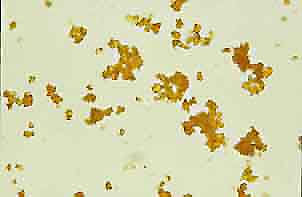
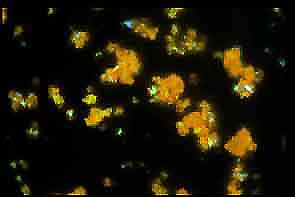
Under the microscope the pigment appears as irregularly-shaped orange particles; a few are transparent but most are likely to be translucent and have a rough surface. Some of the transparent particles are likely to be pleochroic. Between crossed polars the large rough particles are likely to appear orange but small transparent particles often show what appears to be a second order blue or green when grey would have been expected, and these anomalous colours make the pigment extremely easy to recognise. Small elongated transparent particles extinguish parallel.
The pigment was made by roasting metallic lead to oxidise it, and then heating the resulting litharge for several hours at a temperature of about 480° C in an oxidising atmosphere. Some free litharge may be found in some samples of the pigment. Hurst quotes figures from Gmelin in connection with the production of massicot which suggest that repeated firings were necessary to ensure that a high proportion of the litharge was converted.
Red lead is of great antiquity and was used not only in Europe but in the East. It was mentioned by Pliny and used in Japan by the eighth century A.D. In China in may have been used as early as the fifth century B.C. and was certainly used during the Han dynasty (2nd century B.C.) [Artists’ Pigments Vol I]. It was regularly used by Arab and Byzantine illuminators. It is still, or was until recently, used as a priming coat for structural steelwork, particularly on ships. The pigment is reputed to be unstable as in can turn brown from the formation of brown lead dioxide on exposure to light and air, particularly when used in an aqueous medium. Although it has been regarded as unstable by much of the artistic establishment, many old examples have been found in good condition. Hydrochloric acid turns it white, sulphides and hydrogen sulphide are supposed to blacken it, but it is not affected by dilute alkalis. It tends to have a poor reputation and Cennini says that it is good for painting on panels but not on walls. Nevertheless, many examples have stood well, and the authors cannot help wondering how much of the trouble is due to the presence of litharge which discolours very readily. They have found examples of red lead mixed with vermilion and bound both in oil-resin and watercolour mediums on seventeenth- and eighteenth-century harpsichords in which the colour has not been affected. The red lead could have been added to reduce the amount of a more costly pigment, or, when in oil, it could have been intended to improve the drying of what is otherwise a poor dryer. However, in the soundboard decoration on one harpsichord the authors found red lead had been used alone as well as mixed with vermilion, while pure vermilion had also been used. This would appear to imply that the painter had chosen to use the mixture on account of its colour. By the 1920s a type of red lead had been developed which was called ‘non-setting’ red lead. Heaton mentions a 1928 British Engineering Standard Specification which required that such paints should be of a certain consistency after exposure to the air in open containers for 14 days. It would seem that this variety of red lead contained no, or virtually no, free litharge. The existence of non-setting red lead probably accounts for the commend in OCCA Vol I that red lead in oil is a poor dryer.
Orange lead, also sometimes called ‘orange mineral’, is similar chemically to red lead but is made by roasting lead white. It is a bulkier pigment than red lead with a higher oil absorption, and it has a lower specific gravity (about 6.95 as opposed to 8.73). Because of its great durability in oil, it was used as an anti-corrosive paint and for priming wood. Orange lead is also used as a lake base primarily in imitations of vermilion. The authors believe it to be similar to red lead microscopically.
Vermilion
Cinnabar, Chinese vermilion, scarlet vermilion. N.B. ‘Chinese vermilion’ is a term that can refer to an imitation vermilion as well as genuine vermilion prepared in China.
Red mercuric sulphide HgS.
Refractive index 2.81 to 3.14; trigonal.
There four distinct forms of this pigment: dry process, wet process, rhombohedral and natural cinnabar.

Dry-process vermilion appears, in plane polarised light, as elongated or broken particles in a wide range of sizes. Large particles are red or orange, while small particles tend to appear yellow. The particles, which show high relief, may be transparent or show striations, and some are likely to have parallel sides, which will also be parallel to the striations if they are present, and irregular or slightly rounded ends. Some particles are likely to show pleochroism, changing in tone from a stronger to a weaker orange or yellow. Between crossed polars the pigment appears a fiery red, with orange and yellow lights. The extinction is parallel.

Notice how dark many of the smaller particles appear.
Wet process vermilion particles tend to be very even and small in size, and equant in shape. They are more opaque than those made by the dry process, and, in plane polarised light, they exhibit high relief and appear very dark, or almost black. The particles are too small for pleochroism to be observed. Between crossed polars the pigment shows orange and yellow interference colours.
Rhombohedral vermilion is the name The authors use for those sample of vermilion that contain small, square and rectangular, orange or red, crystals, which extinguish in the symmetrical position and do not show pleochroism.
Natural cinnabar of exceptional purity appears similar to the dry process pigment and it may not be possible to distinguish one from the other. However, in most instances samples of cinnabar contain particles of quartz, feldspar or other earthy materials showing that the pigment has been dug or mined.
To prepare vermilion by the dry method, sulphur is combined with mercury in an iron pan to make black mercuric sulphide. This is heated in retorts and the red form is collected as a sublimate which covers the inside of the top of the retort. Strong alkali is used to dissolve the free sulphur. To make vermilion by the wet process, the mercury and sulphur are ground together in the presence of water, and towards the end of the grinding operation, a warm solution of caustic potash is added. After stirring for some time, the pigment develops the desired colour. It has then to be washed and ground. There were a number of slight variations to the process. Potassium pentasulphide is used instead of caustic potash in one version.
Natural cinnabar occurs in many parts of the world and this was used as a pigment in the classical period. However, the authors were given a ground sample of natural cinnabar that had come from a living Russian icon painter who collected natural minerals and used them in her painting. By the eighth century, dry process vermilion was being made in Europe, and it is likely that it was prepared in China as early as the fourth century B.C. Natural cinnabar had a ritual use in the early south American civilizations. The wet process was first used commercially by the Germans at the end of the eighteenth century although the process was understood by the end of the seventeenth century [Studies in Conservation vol 17 No. 2 p. 50]. It is not clear when rhombohedral vermilion was made. It occurs in a decoration that may be eighteenth century on a harpsichord, and has been found on window reveals that are believed to have been painted in the late nineteenth century. Dry process vermilion continued to be made in England until the 1860s. Until about 1760 most of the vermilion used in England was imported from Holland, after which English vermilion acquired the reputation of being adulterated with red lead. During the nineteenth century a considerable amount of wet process vermilion was imported from Germany while reputed dry process vermilion for artists’ use came from China. However, writing at the end of the nineteenth century, Church says that most of the Chinese vermilion imported at that time was English vermilion that had been shipped out to China and then re-imported after it had been packed in Chinese paper. Dry process vermilion was being made in China in the 1950s and it is possible that it is still being made there. A sample of vermilion that came from Hong Kong in about 1997 had clearly been made by the dry process.
Vermilion has always been a fairly expensive pigment and liable to adulteration. Cennini recommends buying the whole lump from the inside of the retort, and much the same advice is given by John smith when he says that ‘the best way to buy it is in the stone; for otherwise it may be sophisticated and spayled with red lead if bought in the powder’. The authors have found a number of examples of vermilion used on applied art objects that included some red lead. It has never been entirely clear whether this was merely a matter of simple sophistication, or whether when the vermilion was dispersed in oil or varnish the red lead had been added to promote drying. That this practice was acceptable and was not necessarily an underhand method of reducing the price of an expensive pigment is indicated by the following entry from the Royal accounts. In 1532 Thomas Angus and Alexander Chalmer were working at Holyrood and were paid 22 pounds “for the paynting and laying of thre irne yettis [gates] and xvi grete irne windois with all the remanent of the windois and irne werk withing the new werk with reid leid and wermelone and uley [oil] …” Accounts of the Master of Works for building and repairing Royal Palaces and Castles Vol I 1529-1615, Edit Henry M. Paton, p. 86. Note that the pound Scots fluctuated in value, but was usually worth substantially less than the English pound at the same period.c.f.
Vermilion is a reasonably permanent pigment. It is unaffected by normal heating, and is insoluble in alkalis and most concentrated acids, but it is soluble in aqua regia. It can be used with other pigments; mixtures of vermilion and white lead were used successfully by a number of painters. However, it has been found that vermilion tends to destroy oil and varnish binders, and when a area of vermilion has to be cleaned it tends to be very sensitive to solvents. It has been used by artists for centuries. Some samples of vermilion have, however, discoloured, as the red form can revert to the black. Church says that three months exposure in a south-facing window will blacken a vermilion paint, but that it will be unaffected in normal room lighting. The wet process material appears to be more likely to blacken than the dry, and one of the samples of rhombohedral vermilion the authors have seen came from a black surface and included blackened particles. The colour can vary slightly from batch to batch, and it has been suggested that this is related to the particle size, the coarse dry-process vermilion being browner. However, the authors have found examples of quite finely ground dry-process vermilion in Burmese brownish-red lacquer, while other samples which appeared to be coarser, were a better red. This was not a question of exposure to the light, as the bases of the boxes were the same colour as the sides and tops. Vermilion is a very strong colour with good covering power. The high specific gravity can cause it to settle in a layer. The result is that if the layer has been allowed to dry in a horizontal position, the layer of vermilion can settle with the coarsest particles at the bottom, grading to finer particles on top and the layer can be covered with a layer of the medium, although the paint was applied in one coat and thoroughly mixed. The authors have seen several pieces of eighteenth-century furniture that have been painted using this technique. The effect can be wonderful, and it appears similar to paint that has been applied in multiple layers, each with a higher proportion of medium and each rubbed down, before the next is applied. Vermilion is difficult to disperse, particularly in aqueous mediums, unless it is first wetted out with alcohol.
Vermilionettes and Royal reds are imitations of vermilion, which Hurst, writing at the end of the nineteenth century, says, ‘were introduced to this country some twelve or fourteen years ago’ by the Silicate Paint Company of Liverpool and by Messrs J. B. Freeman & Co of London respectively. he comments that they had already displaced vermilion to a considerable extent. They were sold under a variety of names such as Victoria red and signal red. They were made in a number of ways, the most usual being to dye orange lead with an eosin dye, but in some versions barytes, or a mixture of barytes and orange lead were used as the base. When pigments of this type are mounted in Meltmount, the dye is often carried by the mountant to the edge of the cover slip.
Mactaggart, P. & Mactaggart, A. (June 2007) ‘Red Pigments’ In: Pigment ID using Polarised Light Microscopy from: https://academicprojects.co.uk/red-pigments/
